


Qualcomm Reportedly Taking Notes from Samsung’s Exynos Playbook: The processor rumored for the Galaxy S27 Ultra may incorporate a cooling feature inspired by the Exynos 2600, but insiders claim it won’t be as effective as Samsung’s version.
The claim comes from Reptalica, a chip-focused account on X, who said the Snapdragon 8 Elite Gen 6 Pro will carry a version of the Heat Path Block, the copper heat sink that debuted in the Exynos 2600. The tipster said Qualcomm’s version “isn’t as effective” as Samsung’s but gave no reason. PhoneArena and Wccftech first reported the comments.
How a Heat Path Block Improves Thermal Performance
Heat Path Block, or HPB, is a copper sink that sits against the processor, pulls heat off it and spreads that heat inside the phone so other components do not overheat. Samsung introduced it on the Exynos 2600, the first phone chip built on a 2-nanometer process. Android Authority reported the design cuts thermal resistance by about 16 percent and helps the chip hold performance under heavy load.
The detail matters because Qualcomm’s current flagship runs hot. The Snapdragon 8 Elite Gen 5 has drawn criticism for high temperatures in the Galaxy S26 and other phones, so any cooling gain on its successor is worth watching.
Which Chip Is Right for You? A Clear Comparison
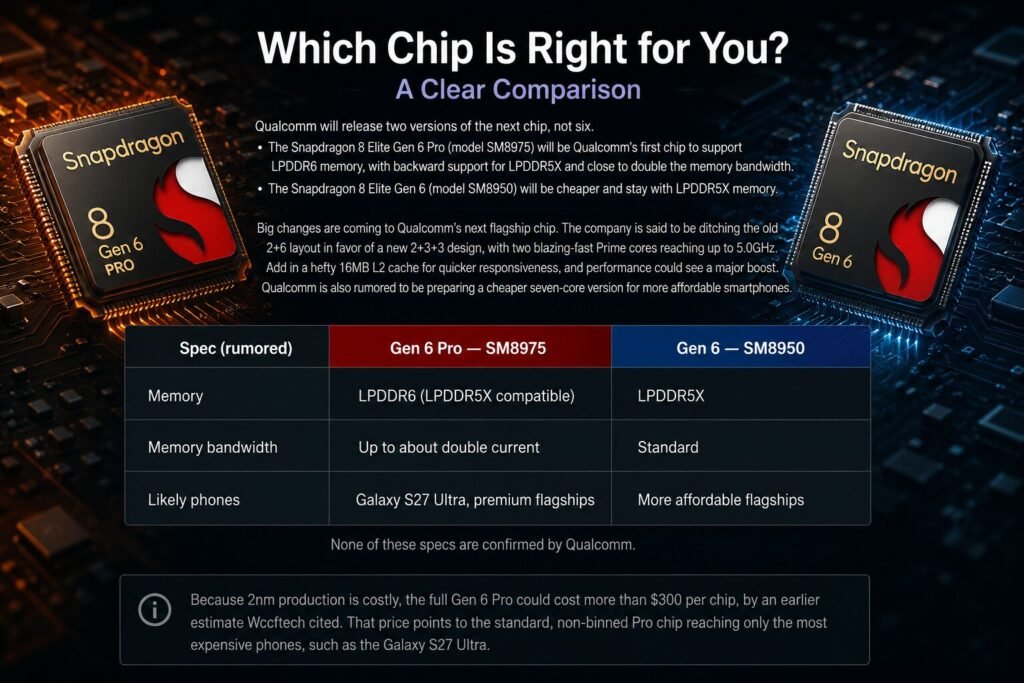
Reptalica also corrected a separate rumor. Qualcomm will release two versions of the next chip, not six, the tipster said:
- The Snapdragon 8 Elite Gen 6 Pro (model SM8975) will be Qualcomm’s first chip to support LPDDR6 memory, with backward support for LPDDR5X and close to double the memory bandwidth.
- The Snapdragon 8 Elite Gen 6 (model SM8950) will be cheaper and stay with LPDDR5X memory.
Big changes are coming to Qualcomm’s next flagship chip. The company is said to be ditching the old 2+6 layout in favor of a new 2+3+3 design, with two blazing-fast Prime cores reaching up to 5.0GHz. Add in a hefty 16MB L2 cache for quicker responsiveness, and performance could see a major boost. Qualcomm is also rumored to be preparing a cheaper seven-core version for more affordable smartphones.
| Spec (rumored) | Gen 6 Pro — SM8975 | Gen 6 — SM8950 |
|---|---|---|
| Memory | LPDDR6 (LPDDR5X compatible) | LPDDR5X |
| Memory bandwidth | Up to about double current | Standard |
| Likely phones | Galaxy S27 Ultra, premium flagships | More affordable flagships |
None of these specs are confirmed by Qualcomm.
Because 2nm production is costly, the full Gen 6 Pro could cost more than $300 per chip, by an earlier estimate Wccftech cited. That price points to the standard, non-binned Pro chip reaching only the most expensive phones, such as the Galaxy S27 Ultra.
What Users Can Expect from the S27 Ultra
The “less effective” assertion should be viewed skeptically. It is based on information from just one tipster, lacks supporting evidence, and references a processor and handset that are still far from launch. The Galaxy S26 debuted in February, and the next-generation model is unlikely to arrive until early 2027.
A single component also says little about how hot the S27 Ultra will actually run. Phone temperature depends on the whole cooling stack — the process node, the chip layout, the vapor chamber and the phone’s body — not on the heat sink alone. Samsung designs the Exynos and its HPB together and controls the packaging, which may be why a copied version on a different chip and process falls short.
There is a simpler reading, too. The Gen 5 shipped with no HPB and ran hot. A Gen 6 Pro with even an imperfect version of the feature could still run cooler than the chip it replaces. A weaker version of Exynos cooling is not the same as bad cooling.
Questions readers are asking
When does the Galaxy S27 Ultra launch?
Samsung has not announced a date. Based on its recent pattern, with the S26 line launching Feb. 25, the S27 series is expected in early 2027.
Will the S27 Ultra use Exynos or Snapdragon?
Reporting points to the Snapdragon 8 Elite Gen 6 Pro. Samsung has used Qualcomm chips in every recent Ultra worldwide.
What is Heat Path Block?
A copper heat sink that contacts the processor and moves heat away from it to keep performance steady.
What’s next
Samsung is already working on a stronger version of the technology.
The Exynos 2700 is expected to use a second-generation HPB in a “Side-by-Side” layout that places the processor and memory next to each other under one heat sink.
Qualcomm and Apple have both been linked to HPB-style cooling for their own chips, according to earlier reports.






















Leave a Reply