

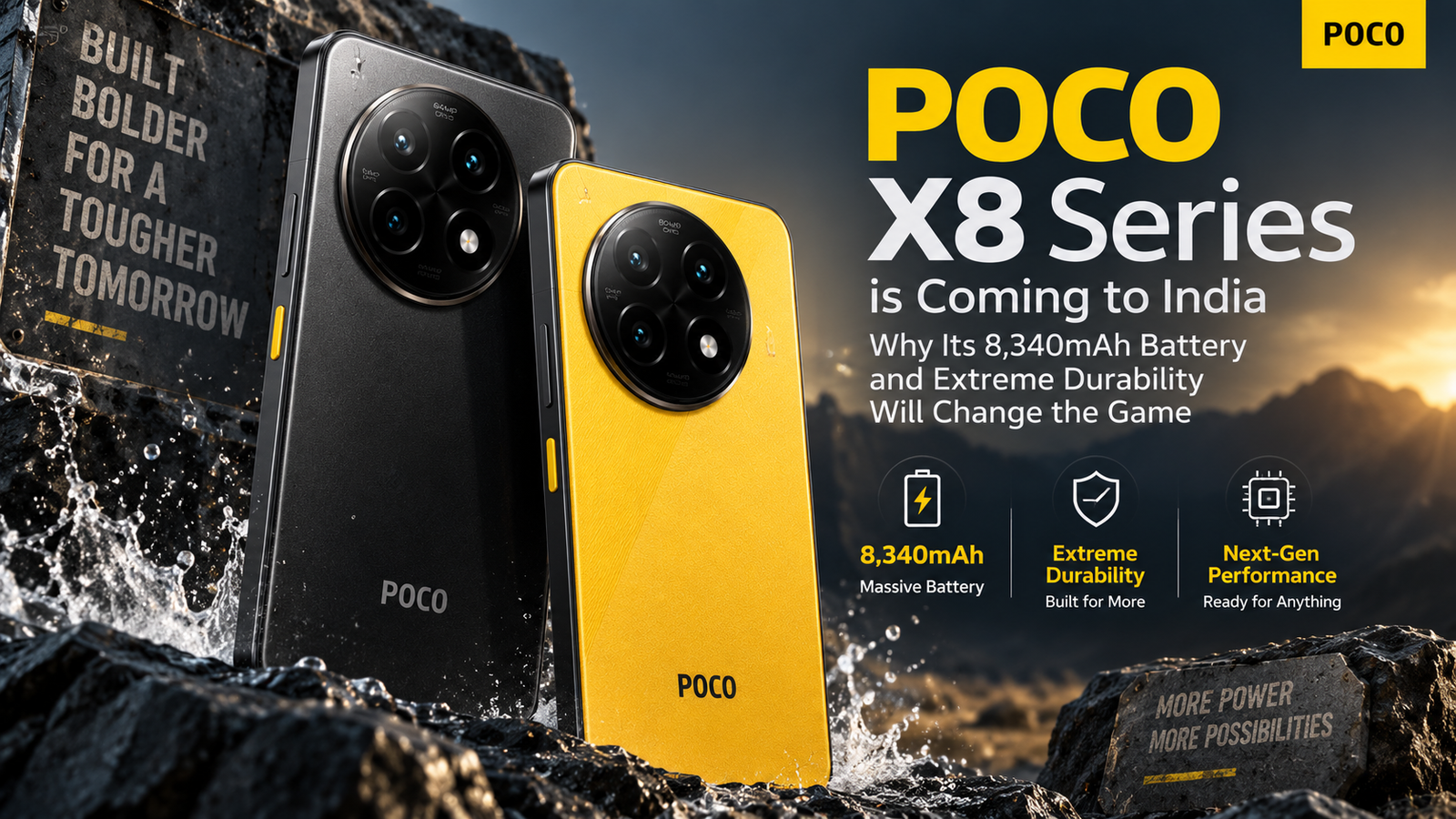
Poco’s upcoming X8 series appears to be taking a different approach to the crowded mid-range smartphone market. Instead of relying on a single headline feature, the company is building its new phones around a combination of large batteries, high-refresh-rate displays, stronger durability and long-term software support.
The Poco X8 and Poco X8 Power are scheduled to launch in India on September 4, and the specifications revealed so far suggest that endurance could become the defining theme of the series.
Poco X8 vs. X8 Power: 10,000mAh Capacity and 100W Fast Charging Explained
The biggest separation between the two models is expected to come from battery capacity.
The standard Poco X8 is tipped to feature a 6,800mAh battery, while the Poco X8 Power could push things further with a massive 10,000mAh battery. If the final specifications deliver as promised, the Power model could stand out in a market where most mainstream smartphones still operate around the 5,000–6,000mAh range.
That matters because smartphone usage has changed. For younger users, a phone is no longer just used for calls and messaging. It handles streaming, gaming, navigation, photography, social media and increasingly AI-powered features—all of which consume power.
A larger battery could mean less dependence on power banks and charging sockets.
Poco says the standard model will support 67W wired charging, while the X8 Power is expected to support 100W charging. Both devices are also said to include 22.5W wired reverse charging, allowing them to potentially charge accessories or other smartphones.
The obvious question, however, will be size and weight. A 10,000mAh battery sounds impressive, but real-world comfort will depend heavily on how Poco manages the phone’s thickness and ergonomics.
A Display Built for Binge-Watching and Endless Scrolling
Both smartphones are expected to feature a 6.83-inch AMOLED display with a 120Hz refresh rate and peak brightness of up to 3,500 nits.
For everyday users, 120Hz is about more than a specification on a product page. Higher refresh rates make scrolling, animations and supported games feel noticeably smoother.
The large AMOLED panel also positions the X8 series as a device aimed at entertainment-heavy users. Whether it is watching content, gaming or endlessly scrolling through social platforms, the display could become one of the phones’ strongest practical features.
Rain, Drops, and Travel: How the Poco X8 Survives Unpredictable Days
One of the more interesting aspects of the launch is Poco’s focus on environmental protection.
The standard Poco X8 is expected to receive IP66, IP68, IP69 and IP69K ratings, covering different levels of protection against dust and water. It will also reportedly include Corning Gorilla Glass 7i protection.
This reflects a wider shift happening in smartphones. Durability is becoming a competitive feature rather than something reserved for rugged devices or ultra-premium flagships.
For buyers, stronger protection potentially means greater confidence when using the phone during rain, travel or unpredictable daily situations. But as always, water-resistance ratings should not be interpreted as an invitation to deliberately expose a phone to water.
No Lag, No Overheating: What to Expect from the Snapdragon 7s Gen 5
Under the hood, the Poco X8 Power is expected to run on Qualcomm’s Snapdragon 7s Gen 5 chipset. Poco has also highlighted an AnTuTu benchmark score exceeding one million points.
Benchmark numbers can be useful for comparing hardware potential, but they do not tell the entire story. Software optimization, thermal management and sustained performance matter far more during long gaming sessions or extended multitasking.
Both models are expected to come with 8GB RAM, placing them firmly in the performance-focused mid-range category.
The bigger test will be whether Poco can maintain smooth performance after months of software updates and heavy usage—a challenge where many specification-heavy smartphones struggle.
A Camera Built for Everyday Memories, Not Spec Wars
The leaked information so far suggests that Poco is prioritizing endurance and performance rather than positioning the X8 series as a camera-first smartphone.
The standard X8 is expected to feature a 50MP Sony primary camera, while the full camera configuration and real-world image processing capabilities remain important details to watch.
This could reveal Poco’s strategy clearly: instead of trying to beat camera-centric competitors in every category, the company may be targeting users who want a phone that lasts longer and handles demanding everyday usage without constant charging anxiety.
Beyond the Specs: How Android 16 and HyperOS 3 Keep Your Phone Feeling New
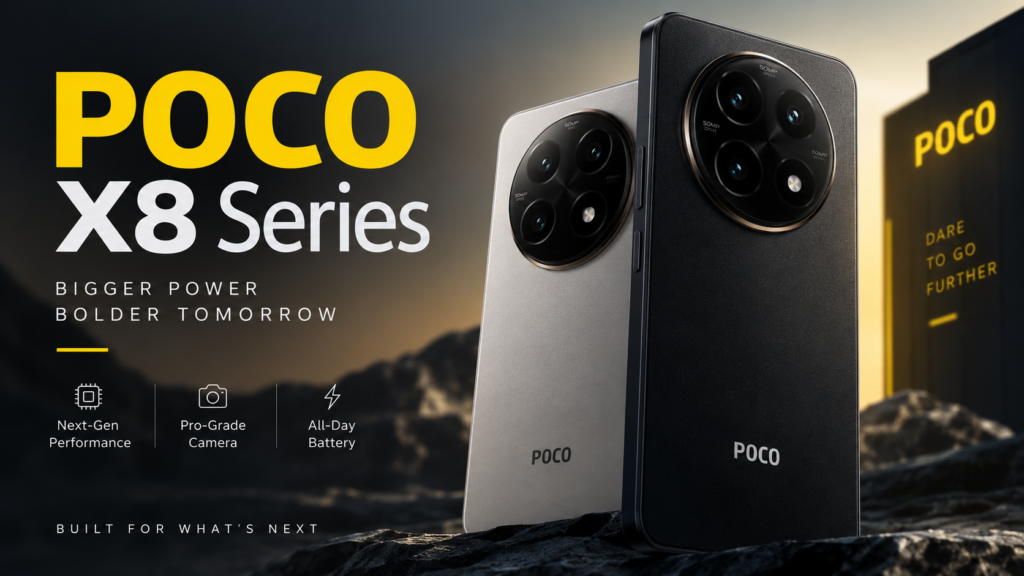
Perhaps one of the most important announcements is Poco’s software commitment.
For young smartphone buyers, this could matter more than another incremental processor upgrade.
Phones are becoming more expensive, and consumers are keeping them for longer. Extended software support improves the long-term value of a device and potentially reduces the pressure to upgrade every two years.
The real importance of the X8 series may therefore not be what it can do on launch day, but whether it remains reliable several years later.
The bigger picture: Poco is betting on endurance
The Poco X8 series appears to represent a broader shift in the smartphone industry.
For years, manufacturers competed aggressively over cameras, benchmark scores and charging speeds. Those features still matter, but battery life and durability are becoming increasingly important as smartphones take on more responsibilities in everyday life.
The X8 Power’s 10,000mAh battery, in particular, could become its biggest talking point. If Poco manages to combine that capacity with reasonable weight, effective cooling and fast charging, it could create a compelling option for power users.
The standard X8, meanwhile, seems positioned as the more balanced choice, combining a large battery, high-refresh-rate AMOLED display and stronger durability features.
With pricing still to be revealed, that will ultimately determine how disruptive the Poco X8 series really is.
The specifications look ambitious. The real question is whether Poco can price that ambition aggressively enough to shake up India’s highly competitive smartphone market.














Leave a Reply