

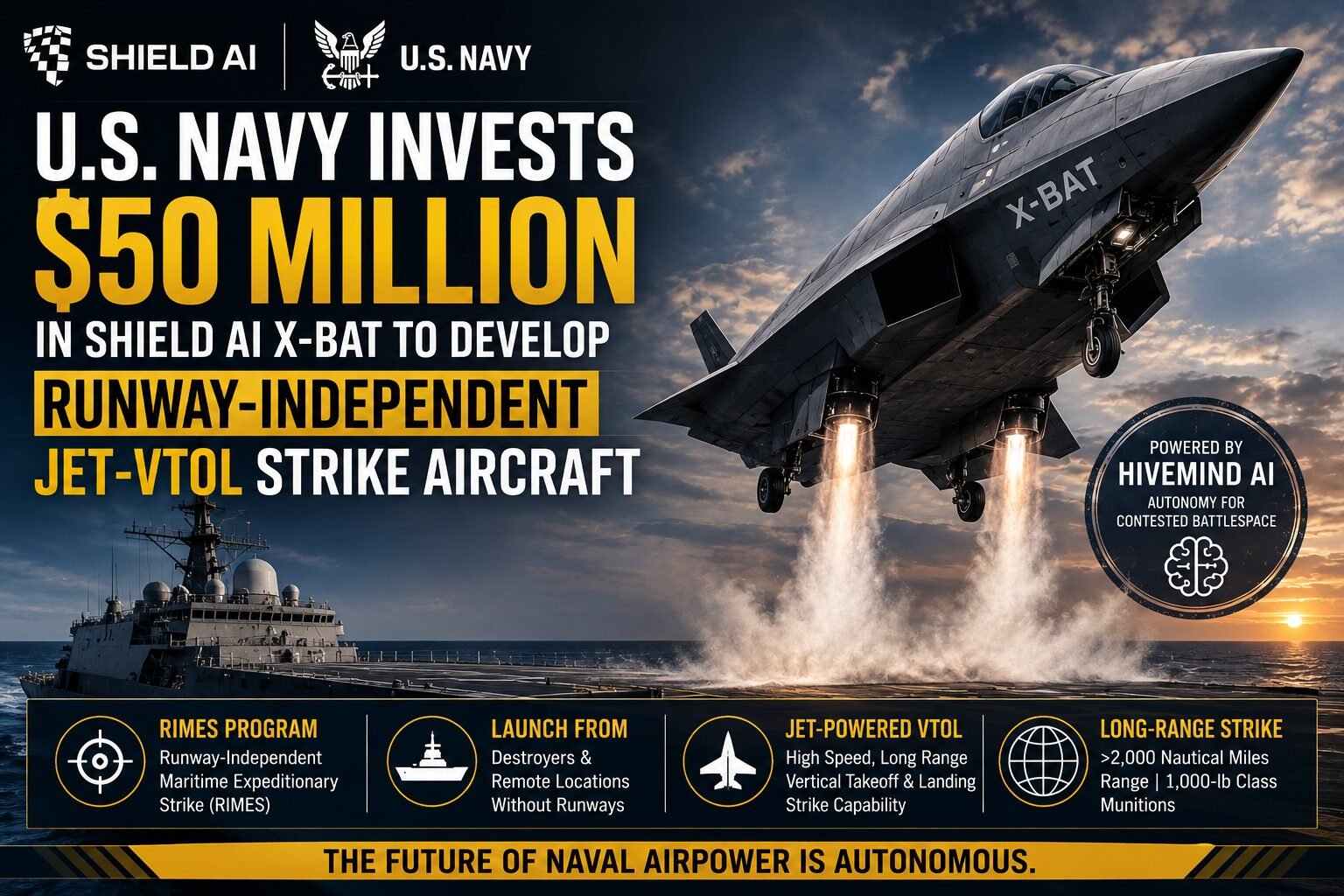
Shield AI X-BAT Gets Major U.S. Navy Backing
The U.S. Navy and the Defense Innovation Unit (DIU) are backing Shield AI’s X-BAT autonomous aircraft as part of an effort to develop a long-range strike capability that can operate without a conventional runway or aircraft carrier.
According to the source material provided to DailyAIWire, the Navy has committed $50 million to the X-BAT effort under the Runway Independent Maritime Expeditionary Strike (RIMES) program. The investment represents a significant step for Shield AI as it moves beyond providing AI autonomy software and begins developing its own jet-powered aircraft.
The X-BAT is designed around a difficult combination of requirements: vertical takeoff and landing, fighter-class performance, long-range strike capability and autonomous operation.
Shield AI describes X-BAT as an AI-piloted VTOL aircraft intended to operate from ships, remote locations and austere environments without conventional runway infrastructure.
Why the U.S. Navy Wants a Runway-Independent Strike Drone
The RIMES program addresses a specific problem facing U.S. Navy surface combatants.
Arleigh Burke-class destroyers can launch helicopters, but they do not have the large flight decks, catapults or arresting systems required for conventional fixed-wing strike aircraft.
The RIMES requirement therefore focuses on an unmanned aircraft that can:
- Launch and recover with minimal infrastructure
- Operate from ships without large flight decks
- Travel at least 1,400 nautical miles
- Carry approximately 1,000-pound-class munitions
- Operate autonomously in contested environments
- Require limited personnel and support equipment
- Integrate with existing naval systems
The Navy’s February 2026 solicitation described these requirements as part of a broader effort to provide reusable, long-range strike capability from expeditionary locations and smaller surface combatants.
This creates a fundamentally different mission concept from traditional carrier aviation.
Instead of depending exclusively on aircraft carriers or land-based airfields, a runway-independent aircraft could potentially distribute long-range airpower across a much larger number of naval platforms.
X-BAT Is Not a Conventional Drone
The Shield AI X-BAT is designed as a tail-sitting, jet-powered VTOL aircraft.
The aircraft launches vertically, transitions into horizontal flight and eventually reverses the process for recovery.
That sounds straightforward, but the transition between vertical and horizontal flight is one of the hardest engineering problems in the X-BAT program.
During vertical flight, conventional aerodynamic control surfaces such as ailerons, elevators and rudders have limited authority because there is not enough airflow over them.
The solution being tested by Shield AI is the Axisymmetric Vectoring Exhaust Nozzle, or AVEN.
AVEN: The Technology Behind X-BAT’s Vertical Flight
AVEN is a thrust-vectoring nozzle originally developed by GE Aerospace during the 1990s for the Multi-Axis Thrust Vectoring program.
Unlike conventional two-dimensional thrust-vectoring systems, the AVEN uses an axisymmetric exhaust configuration capable of redirecting engine thrust in multiple directions.
For X-BAT, that capability is intended to provide aircraft attitude control during the critical vertical-flight and transition phases.
The PDF provided to DailyAIWire reports that the original AVEN system underwent extensive testing during the earlier program, including 87 hours of ground testing and 135 flight hours across 95 sorties.
In July 2026, Shield AI and GE Aerospace announced that they had completed integration, actuation and engine light-off testing of the AVEN system with a GE F110-GE-129E engine at GE Aerospace’s test facility in Peebles, Ohio. GE said the campaign cleared an important path toward X-BAT’s vertical flight testing.
This milestone matters because X-BAT’s entire runway-independent concept depends on reliable control during vertical takeoff, transition and recovery.
Hivemind AI Gives X-BAT Its Autonomous Pilot
The aircraft is only one half of Shield AI’s strategy.
The other half is Hivemind, the company’s AI autonomy system.
Hivemind is designed to allow aircraft to operate in environments where GPS and communications may be unavailable or disrupted.
Instead of continuously relying on a remote human pilot or conventional satellite navigation, the system can use onboard sensing and computing to understand the aircraft’s surroundings and execute its mission.
Shield AI says Hivemind has already been deployed across multiple platforms and is designed for operations in GPS- and communications-denied environments.
The PDF describes visual odometry as one of Hivemind’s navigation mechanisms. In simple terms, the aircraft can compare successive camera images to estimate changes in its position and orientation.
That capability becomes particularly important in electronic-warfare environments where GPS signals can be jammed.
Why GPS-Denied Autonomy Matters
Modern military operations increasingly assume that satellite navigation and communications can be disrupted.
A drone that stops functioning when GPS disappears has a major operational weakness.
Shield AI’s approach is to move more of the navigation and decision-making capability onboard the aircraft.
The company’s existing Hivemind deployments provide an operational foundation for that strategy. Shield AI says its V-BAT systems have conducted hundreds of sorties in Ukraine in environments affected by GPS jamming and communications disruption.
X-BAT takes the concept further by combining autonomous software with a purpose-built jet-powered aircraft.
From AI Software Company to Aircraft Manufacturer
The X-BAT program represents an important strategic shift for Shield AI.
The company has historically been known primarily for AI pilots and autonomous systems, including Hivemind and the V-BAT.
In February 2026, the U.S. Air Force selected Shield AI as one of the mission-autonomy providers for its Collaborative Combat Aircraft effort.
X-BAT is different.
Here, Shield AI is attempting to control the autonomy stack while also building the aircraft itself.
That means the company is competing in both AI autonomy and military aircraft development.
Shield AI’s own X-BAT specifications currently describe a runway-independent aircraft with a stated maximum range exceeding 2,000 nautical miles, a ceiling above 50,000 feet and a 39-foot wingspan.
X-BAT Development Timeline
The program has moved through several major engineering milestones.
According to Shield AI and the source material provided to DailyAIWire, the development sequence includes:
October 2025: Shield AI publicly unveiled X-BAT.
January 2026: Wind-tunnel testing began.
July 2026: Radar-cross-section testing was reported.
July 2026: AVEN integration and engine testing were completed with GE Aerospace.
Late 2026: Shield AI is targeting initial VTOL flight testing.
2028: The company has stated a target for mission capability.
2029: Shield AI currently lists production as a future milestone.
The transition from ground testing to actual flight will be the next major test of the concept.
Allies Are Also Watching X-BAT
Interest in the technology extends beyond the United States.
The source material reports that Poland has discussed an industrial role in the X-BAT program, alongside a proposal involving an F-16 engine sustainment hub.
Poland has also become a Shield AI customer for the company’s V-BAT system, increasing the possibility of a broader relationship around autonomous military aviation.
The UK Royal Navy is separately pursuing Project VANQUISH, a program seeking a jet-powered autonomous collaborative platform capable of operating from Queen Elizabeth-class carriers without conventional catapults or arresting gear.
Although Shield AI has not publicly confirmed that X-BAT is participating in the VANQUISH competition, the aircraft’s design closely aligns with the type of runway-independent capability being explored.
What the $50 Million RIMES Investment Means
The importance of the reported $50 million investment goes beyond its dollar value.
RIMES is designed as a competitive program rather than a simple procurement of an already established aircraft.
That means the Navy is effectively testing whether industry can solve a difficult operational problem: how to give relatively small surface combatants access to reusable, long-range airpower.
If X-BAT succeeds, the implications could extend beyond a single aircraft.
A destroyer would no longer need a carrier-sized flight deck to potentially launch an autonomous jet-powered strike platform.
That could give naval commanders another way to distribute combat power while reducing dependence on traditional aviation infrastructure.
The Biggest Test Is Still Ahead
Despite the progress, X-BAT remains a developmental aircraft.
Ground testing can demonstrate that the engine, nozzle, controls and autonomy systems work individually or in an integrated test environment. Actual flight testing introduces another level of complexity.
The first VTOL flight will have to demonstrate that X-BAT can safely control its attitude during launch, transition into forward flight, return to a vertical-flight configuration and recover.
The aircraft must ultimately combine several demanding capabilities:
Jet propulsion + VTOL flight + autonomous navigation + long-range endurance + weapons carriage + shipboard operations.
That combination is what makes X-BAT unusual.
Bottom Line
The Shield AI X-BAT is emerging as one of the more ambitious autonomous aircraft programs in the U.S. defense sector.
Its significance is not simply that it is an AI-powered drone.
The bigger idea is runway-independent airpower — a jet-powered autonomous aircraft capable of operating from locations where conventional fighter aircraft cannot.
The reported $50 million U.S. Navy RIMES backing, combined with the successful AVEN integration and engine testing, moves the X-BAT program from an ambitious concept toward a more serious flight-test campaign.
The decisive milestone will come when X-BAT leaves the ground.
If Shield AI can successfully demonstrate vertical flight, transition and autonomous operation, the program could provide the U.S. Navy with a new option for extending long-range strike capability from ships that were never designed to operate conventional fighter aircraft.
Frequently Asked Questions
What is Shield AI X-BAT?
Shield AI X-BAT is an AI-piloted, jet-powered vertical takeoff and landing aircraft designed for autonomous operations from runways, ships and austere locations. Shield AI says the aircraft is intended for contested environments and can operate without conventional runway infrastructure.
What is the RIMES program?
RIMES stands for Runway Independent Maritime Expeditionary Strike. The program seeks unmanned aircraft capable of conducting long-range strike missions from expeditionary locations and naval vessels without large flight decks.
How far can the X-BAT fly?
Shield AI currently lists a maximum range of more than 2,000 nautical miles for X-BAT.
What is Hivemind AI?
Hivemind is Shield AI’s autonomy technology designed to enable aircraft and other platforms to perform missions with reduced dependence on GPS, communications links and continuous remote control.
What is the AVEN nozzle?
AVEN stands for Axisymmetric Vectoring Exhaust Nozzle. It is a thrust-vectoring system integrated into X-BAT’s propulsion architecture to provide control during vertical flight and the transition between vertical and horizontal flight. GE Aerospace and Shield AI completed an integrated AVEN engine-testing campaign in July 2026.
When will X-BAT fly?
Shield AI currently states that first flight is planned for 2026, with mission capability targeted for 2028 and production listed for 2029.























Leave a Reply