
The rejection of Stephen Thaler’s attempt to register an AI-generated artwork in India is more than another “AI can’t own copyright” story. It exposes a much bigger challenge: our legal system still assumes that creativity begins with a human being.
Artificial intelligence can now generate paintings, music, films, articles and designs in seconds.
But when an AI system creates something genuinely new, an uncomfortable legal question follows:
Who gets to be called the author?
In India, that question recently came into sharp focus through an application involving DABUS, an AI system associated with inventor Stephen Thaler.
The application sought copyright registration for an artwork titled A Recent Entrance to Paradise, with DABUS presented as the author.
The Copyright Office rejected the application.
But the interesting part is why.
This was not simply a verdict declaring that “AI-generated work cannot be creative.”
The decision goes deeper into a distinction that could shape how copyright law deals with generative AI in the coming years: a work can appear original without giving its authorship to a machine.
AI and Copyright Law in India: Can an AI System Be an Author?
This distinction is at the heart of the debate.
The artwork reportedly satisfied the originality requirement.
The Copyright Office found no indication that it had simply copied an existing work. In other words, the material could be considered independently created.
Yet copyright registration still ran into a different problem.
Indian copyright law connects authorship to legal concepts built around persons. For computer-generated artistic works, the law focuses on identifying the person who causes the work to be created.
That creates an important gap.
An AI system may generate the final output, but the law asks a different question:
Which legally recognized person was responsible for bringing that work into existence?
That is where the DABUS application struggled.
Copyright disputes are becoming increasingly important as generative AI companies face [copyright battles involving AI training data], raising questions about who owns creative work in the age of artificial intelligence.
Can AI Be Granted Copyright? Why the Law Rejects AI Authorship
Stephen Thaler’s position was that DABUS performed the generative process that produced the artwork.
However, the Copyright Office reportedly found that this did not automatically make DABUS a legal author.
Why?
Because authorship in copyright law is not merely about identifying the entity that physically or computationally produced an output.
It also involves legal recognition.
A human artist can own copyright, transfer rights, license a work and be held accountable.
A company can own rights through legal mechanisms. But an AI system does not currently possess independent legal personality in the way a human or corporation does.
That distinction may sound technical, but it has massive consequences.
If an AI were recognized as an author, difficult questions would immediately emerge:
- Can the AI own property?
- Can it transfer copyright?
- Who receives royalties?
- Who is responsible if the work infringes someone else’s rights?
- Can an AI enter into a licensing agreement?
- What happens when the AI system is sold or shut down?
The law currently has no clean answer to these questions.
AI Copyright and Human Authorship: Can You Copyright AI-Generated Art?
The Copyright Office reportedly noticed another problem with how the application identified authorship.
Thaler was listed as an author in one capacity, while DABUS was presented as the author or creator in another. This made the ownership chain difficult to reconcile.
Copyright registration requires clarity.
Someone needs to be identifiable as the legally recognized author or rights holder. Simply placing a human and an AI system together on an application does not automatically solve the problem.
The order therefore highlights something that creators using AI should pay close attention to:
Using AI does not remove the need for a human authorship story.
Someone still needs to explain their role in the creative process.
Did You Make It, or Did the Bot? How India’s Copyright Law Is Drawing the Line on AI Art
Perhaps the most significant part of this debate concerns Section 2(d)(vi) of India’s Copyright Act.
For computer-generated works, the provision identifies the author as the person who causes the work to be created.
That wording was written long before modern generative AI tools became mainstream.
Today, however, it has suddenly become extremely important.
Imagine two situations.
In the first, a person spends hours directing an AI system:
- developing a concept,
- writing detailed prompts,
- generating multiple versions,
- rejecting weak outputs,
- modifying compositions,
- combining images,
- editing the final work.
In the second, a system autonomously produces thousands of images with minimal human involvement.
Should copyright law treat both situations identically?
Probably not.
And this is where future legal disputes are likely to become more complicated.
The question may gradually shift away from “Was AI used?”
Instead, courts may increasingly ask:
“What exactly did the human contribute?”
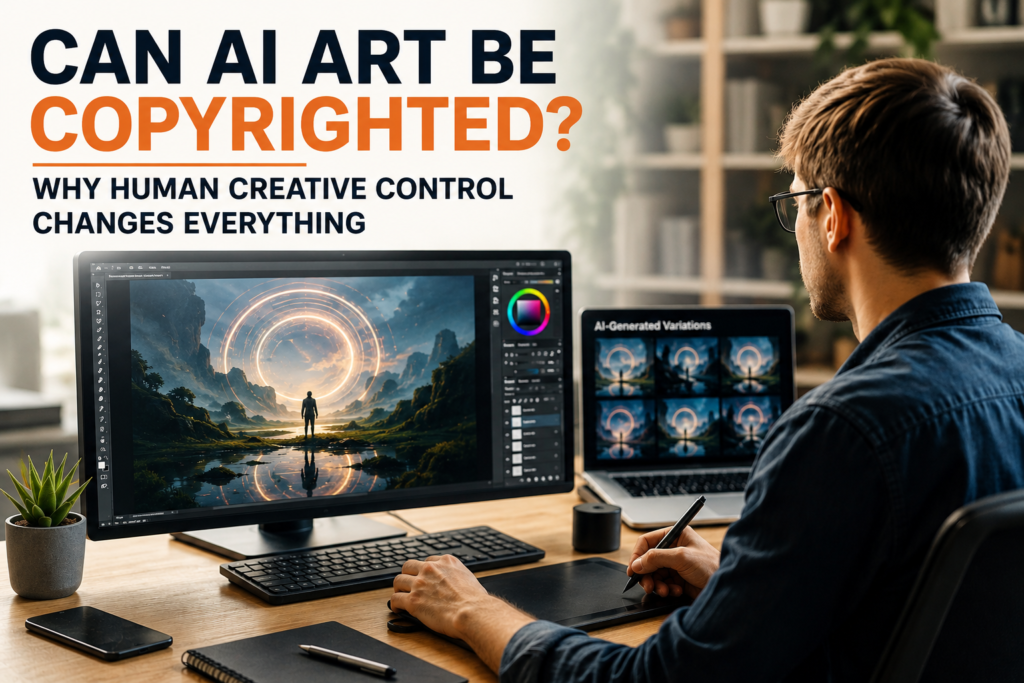
Can AI Art Be Copyrighted? Why Human Creative Control Changes Everything
The DABUS decision does not mean AI-assisted creativity has no place in copyright.
Instead, it suggests that the legally important figure may be the human who exercises meaningful creative control.
That could include:
- selecting the creative objective,
- designing the workflow,
- configuring the AI,
- choosing between outputs,
- editing the generated material,
- arranging multiple elements,
- making final aesthetic decisions.
This distinction matters enormously for artists, designers and content creators.
Simply typing one generic prompt and accepting the first result may present a weaker claim to authorship than a deeply directed creative workflow involving substantial human judgment.
The future copyright debate may therefore focus on creative control rather than technological involvement.
AI could become a tool within the creative process—similar in some ways to cameras, editing software or digital design platforms—without becoming the legally recognized author itself.
Can You Copyright AI Art? What Creators Must Know About AI Ownership
For younger creators, AI is no longer an experimental technology.
It is becoming part of everyday creative work.
Students use AI to generate posters. Musicians experiment with AI-assisted sounds. Designers create concepts through image generators. Filmmakers use AI for storyboards and visual effects.
But the legal infrastructure surrounding these tools is still catching up.
The DABUS case serves as an early warning: creating something with AI and owning clear copyright rights over it are not necessarily the same thing.
Creators may eventually need to document their creative process more carefully.
Keeping records of:
- prompts,
- revisions,
- source material,
- editing decisions,
- creative direction,
could become increasingly valuable when proving human contribution.
The finished image alone may not tell the whole story.
AI Copyright in India: Who Owns AI-Generated Content?
Copyright systems were designed around a relatively simple assumption.
A person creates something.
That person receives certain rights.
Generative AI challenges that assumption because the relationship between creator and tool has become blurred.
A painter holds a brush.
A photographer operates a camera.
A designer controls software.
But what happens when the tool itself appears capable of making unexpected creative decisions?
That is the legal frontier.
The DABUS case shows that India is currently reluctant to cross the line into recognizing an AI system as an independent author.
For now, the legal system appears to be preserving a fundamental principle:
Originality alone is not enough. Copyright also requires legally recognizable authorship.
Can AI Legally Own What It Creates? The Legal Crisis Facing Indian Courts
This debate is far from over.
As AI systems become more autonomous, pressure will grow on governments and courts to clarify what counts as meaningful human involvement.
Future policy could move in several directions.
India could strengthen the existing human-centered interpretation of copyright. Legislators could introduce specific protections for AI-generated works. Or courts could gradually develop new tests for determining how much human creative control is necessary.
But granting AI systems the same legal status as human authors would be a far more radical step—and one that would require changes far beyond copyright law.
Because once a machine becomes an author, society must decide whether it can also become a rights holder.
And that is a much bigger question than who generated a picture.
DABUS Ruling Explained: Why Originality Doesn’t Equal Legal Authorship in India
The DABUS decision is not really about whether machines can produce art.
They clearly can.
The more difficult question is whether producing something is the same as being an author.
Indian copyright law, at least for now, appears to answer that question cautiously.
An AI-generated work may be original. It may be visually impressive. It may even be impossible to distinguish from human-created art.
But originality and legal authorship are two different tests.
As generative AI becomes part of everyday creativity, the most valuable human contribution may no longer be simply making every pixel, word or sound manually.
It may be the human ability to direct, choose, shape, judge and take responsibility for the final creation.
And that could become the defining copyright question of the AI era.








Leave a Reply