
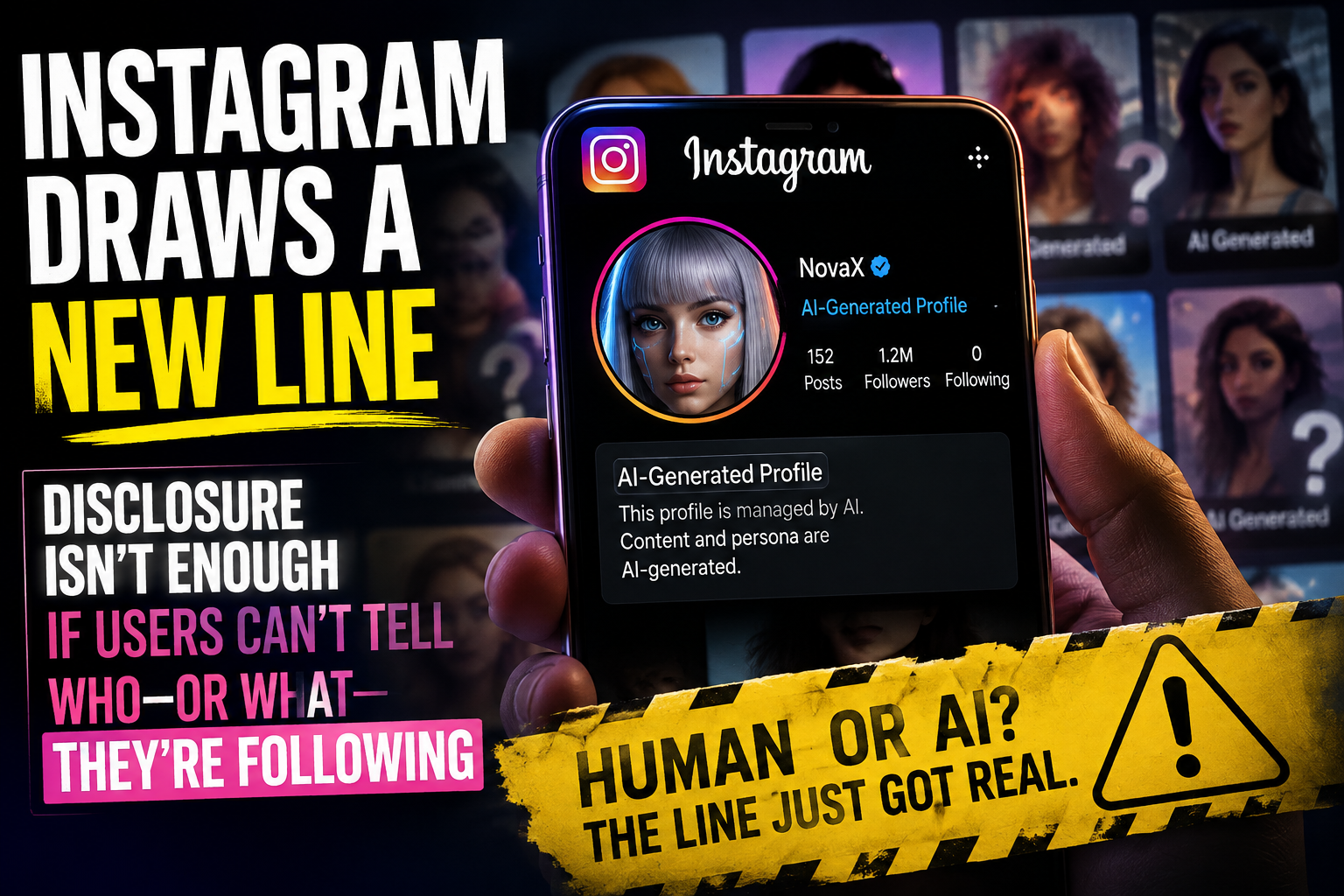
Instagram is tightening its approach to AI-generated profiles, shifting the debate from AI-made content to AI-created identities. The platform’s new rules could reduce the reach of undisclosed virtual personas while giving creators clearer ways to identify profiles built around artificial intelligence.
For years, the biggest question around AI on social media was simple:
Can you tell whether an image or video is fake?
Instagram is now moving the conversation somewhere more complicated.
What happens when the entire person behind an account is artificial?
A profile may post AI-generated selfies, reply to comments, build a following and interact with users just like a human creator.
For someone scrolling through Reels or recommendations, the difference may not always be obvious.
That is the problem Instagram appears to be targeting with tighter rules around AI-generated profiles.
The platform is reportedly replacing its existing “AI creator” terminology with a clearer “AI-generated profile” label.
More importantly, accounts featuring AI-generated people that fail to properly disclose their nature could face reduced distribution across Instagram’s recommendation surfaces.
This is not simply another content-labeling update.
It represents a bigger shift in how social platforms may deal with the growing world of virtual influencers.
Instagram Cracks Down on Fake Human Profiles: Why AI Identity, Not AI Content, Is Meta’s Biggest Threat
There is an important distinction emerging from Instagram’s approach.
Using AI to edit a photograph does not automatically make someone an AI-generated person.
A creator might use AI to improve lighting, generate a background, remove an object or create graphics for a post. That account still belongs to a real human being.
But an account built around a fictional AI personality is different.
Imagine an Instagram profile where:
- The person in every image does not exist.
- Their face is generated by AI.
- Their lifestyle is fictional.
- Their personality is designed for engagement.
- Users interact with them believing they are communicating with a real person.
That is where disclosure becomes important.
Instagram’s updated approach appears focused on helping users understand the identity behind the profile, rather than labeling every piece of AI-assisted content posted online.
In other words, the platform is trying to answer a basic question before users become emotionally or commercially invested in an account:
Is this an actual person—or a generated persona?
Instagram Crackdown Knocks Undisclosed AI Profiles Off Reels and Explore
The strongest part of the update is not the label itself.
It is the potential impact on distribution.
Instagram reportedly plans to limit the reach of profiles featuring AI-generated people when the account does not clearly disclose that identity.
That could affect whether such accounts appear in recommendation-driven spaces where users discover content from people they don’t already follow.
This matters because recommendations are the engine of growth on modern social media.
A creator can have zero followers and still go viral if an algorithm pushes their content to the right audience. But if Instagram reduces recommendation eligibility for certain accounts, growth becomes significantly harder.
The message is clear:
Creating an AI influencer may be allowed. Pretending that the AI influencer is unquestionably human may become much more difficult.
That distinction could reshape an industry that has quietly grown alongside generative AI.
Too Real to Regulate: Why Ultra-Realistic AI Influencers Are Breaking Global Advertising Laws
Early virtual influencers were easy to identify.
They often looked like animated characters, science-fiction avatars or obviously computer-generated personalities.
Generative AI has changed that.
Today, AI can produce highly realistic faces, natural-looking photographs and videos that closely resemble ordinary social media content.
A fictional influencer can appear to travel, attend events, wear branded clothing and share personal stories.
To an average user scrolling quickly through Instagram, there may be little reason to question whether the person is real.
That creates a unique trust problem.
Social media has always included edited identities.
People use filters, professional photography and carefully curated lifestyles.
But AI-generated profiles introduce something fundamentally different: the possibility that the identity itself is synthetic.
Instagram’s move suggests platforms are beginning to treat this as a separate category.
Instagram Algorithm Update: Meta Signals Major Shift Toward Feed Transparency
Traditionally, platform transparency has mostly been a policy issue.
A platform could ask users to add labels or disclosures, but those disclosures didn’t always affect how widely content traveled.
The emerging model appears different.
Disclosure may increasingly become connected to distribution.
If a profile clearly identifies itself as AI-generated, it may continue operating without the same reach penalty associated with undisclosed AI identities. The goal is not necessarily to remove AI personalities from Instagram.
Instead, the platform appears to be creating two lanes:
Transparent AI personas: Users know what they are interacting with.
Undisclosed AI personas: Users may be given fewer opportunities to encounter them through recommendations.
This could become a major principle for future social media moderation.
Rather than banning new technology, platforms may focus on whether users receive enough information to make informed decisions.
Instagram Limits AI Influencer Reach: New Disclosure Rules Threaten Virtual Creator Business
The virtual influencer industry has attracted attention because AI personalities can theoretically operate at a scale human creators cannot.
An AI character doesn’t need sleep.
It can be placed into almost any visual environment.
Brands can control its appearance, messaging and personality with extraordinary precision.
That makes synthetic personalities attractive for marketing experiments.
But there is also a problem.
A brand partnership carries a different meaning when audiences believe they are watching a real human being.
If followers later discover that a personality they emotionally connected with was entirely generated, questions of trust can quickly emerge.
Instagram’s updated labeling approach could therefore affect more than independent AI creators. It could influence:
- Virtual influencer agencies
- AI character startups
- Brands using synthetic ambassadors
- Entertainment companies
- Digital marketing campaigns
- Businesses building AI-powered personalities
The more realistic AI people become, the more valuable transparency becomes.
Why Instagram’s New AI Label Is a Much Bigger Deal Than You Think
AI is already changing how people interact with information online
Instagram’s decision reflects a broader challenge facing the internet.
For decades, online identity worked on a basic assumption: behind most profiles was a human being.
That assumption is weakening.
AI agents are beginning to communicate online.
AI-generated characters are building audiences. Businesses are experimenting with automated personalities. Even customer interactions are increasingly handled by systems designed to sound human.
Social platforms now face a difficult balancing act.
They cannot realistically ban every AI-assisted creative tool. AI is becoming part of normal digital production.
But platforms also cannot ignore the possibility of synthetic identities influencing real people without clear disclosure.
Instagram’s approach points toward a potential future where being transparent about AI is not just an ethical recommendation, it becomes a platform advantage.
Instagram Cracks Down on Fake Humans: Why AI Content and AI Influencers Now Have Different Labels
One of the most important takeaways from the update is that AI use itself is not necessarily the issue.
A photographer can use generative AI.
A designer can use AI tools.
A creator can edit captions with AI.
A video producer can generate visual effects.
None of these automatically turn the creator into an AI-generated profile.
The distinction appears to focus on the person or identity presented to the audience.
That is an important direction because broad AI labeling can quickly become meaningless.
If everything touched by AI receives the same label, users may eventually ignore those labels entirely.
But labeling an account when the central identity itself is synthetic provides more useful context.
It tells users something that directly affects how they interpret the interaction.
What’s Next for Instagram?
Instagram’s move could become an early example of how major platforms handle the next generation of online identities.
The likely future isn’t a simple battle between humans and AI.
It will be a mixed internet.
Real creators will use AI tools. AI characters will attract real followers. Human influencers may work alongside digital versions of themselves. Brands may operate personalities that never physically existed.
The biggest question will no longer be:
“Was AI used to make this?”
Instead, platforms and users may increasingly ask:
“Who—or what—is behind this account?”
That subtle difference could define the next phase of social media.
Instagram’s new direction suggests that AI personas are welcome to participate in the creator economy—but transparency may become the price of being trusted and recommended.
For younger internet users growing up in an era where a realistic face can be generated in seconds, that may be one of the most important changes yet.
Because soon, spotting fake content may not be enough.
The real challenge will be understanding whether the person building influence on your feed ever existed in the first place.












Leave a Reply