
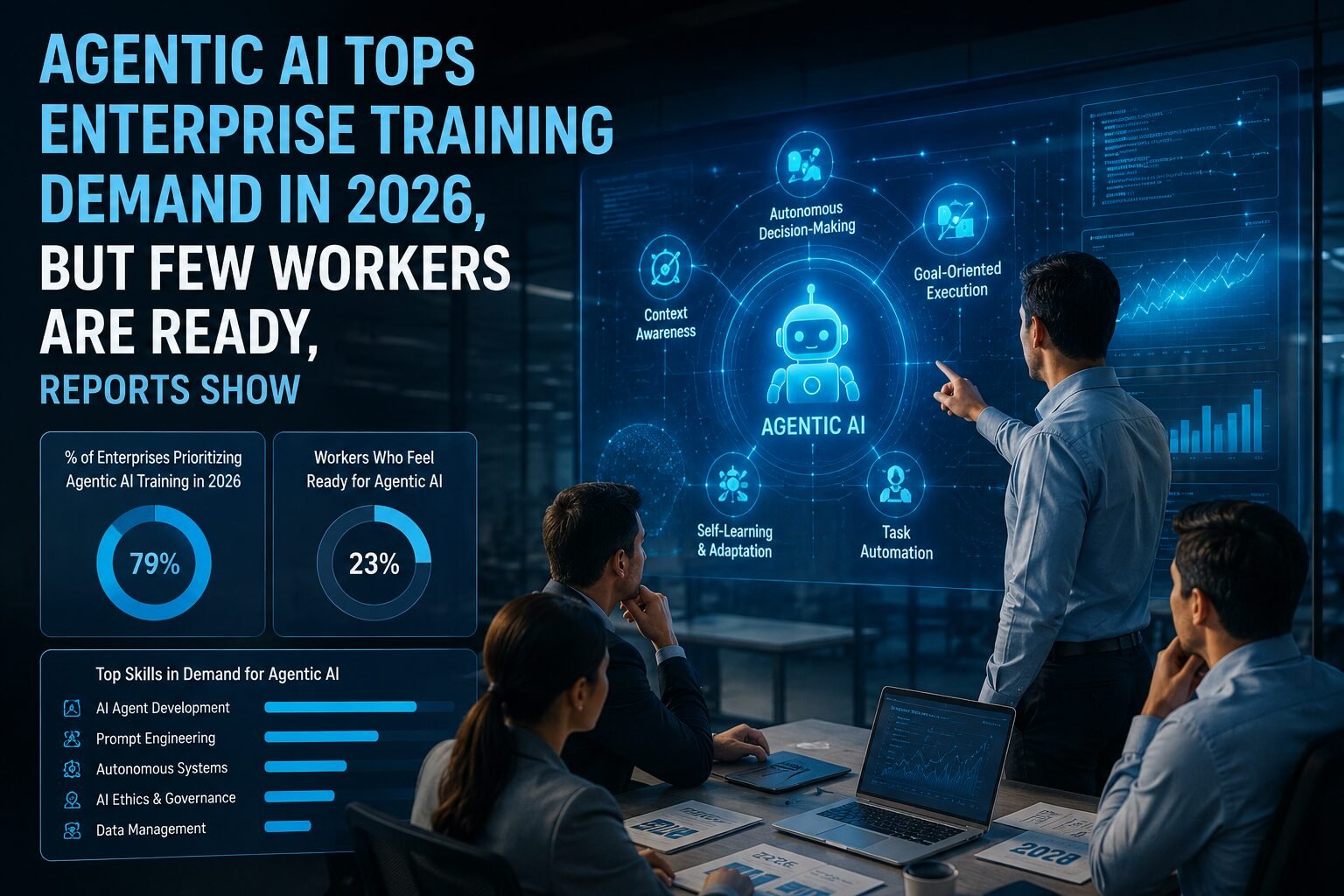
Companies are charging ahead with agentic AI adoption, but their people aren’t keeping pace. 2026 findings highlight AI skills as the most urgent training requirement and the largest capability shortfall across cloud and cybersecurity teams.
Agentic AI, software that can plan and carry out multi-step tasks on its own rather than only answer prompts, has moved from pilots to production this year. Gartner expects about 40 percent of enterprise applications to include task-specific AI agents by the end of 2026, up from fewer than 5 percent in 2025. Demand for the skills to build and oversee those agents has climbed with it.
Why the Preparedness Divide Continues to Widen
The clearest sign of the gap comes from Workera’s 2026 AI Skills Enterprise Benchmark, which drew on more than 88,000 employee assessments. It found that only 13 percent of workers rated as “Accomplished” in agentic AI skills before any training, the lowest score of the 14 capabilities it measured. After targeted training, readiness rose sharply on related skills, which the company said points to a fixable problem rather than a talent shortage.
“Talent is still the greatest multiplier in the AI era,” said Kian Katanforoosh, Workera’s chief executive, who argued that most firms cannot out-hire the gap and must train existing staff instead.
Deloitte’s 2026 enterprise AI report reached a similar conclusion from the leadership side. Executives named the AI skills gap the single biggest barrier to adoption, and more companies adjusted their talent strategy through education than through hiring or redesigning roles.
AI moves to the top of the security training list
The shift is sharpest in cybersecurity. ISC2’s 2026 Security Training Trends report, based on 995 security leaders across six countries, found AI is now the most important training need for 47 percent of them, ahead of cloud computing security and risk assessment. Agentic AI advancements were named by 28 percent, and automation by 24 percent.
According to the report, AI stands apart from past technology waves because of how rapidly it is reshaping the workplace. Unlike cloud migration, which came with a longer adjustment period, AI is forcing organizations to adapt in real time. “We don’t even know what we need yet,” said Casey Marks, COO of ISC2, pointing to the urgent demand for AI tools, training, and operational frameworks. In response, many organizations are replacing off-the-shelf vendor courses with internal training tailored to their specific AI environments and objectives.
Hands-on data backs the trend. A Hack The Box workforce report, drawn from more than 702,000 professionals in 251 countries, found that AI security topics, including prompt injection, machine-learning model exploitation and agentic AI hijacking, are among the fastest-growing areas of cybersecurity practice, with AI penetration testing now a top training priority.
Why India Matters More Than Ever

India sits near the center of this story. In the ISC2 data, cloud computing security, not AI, was the top training priority in India, one of only two countries where AI did not rank first. The Hack The Box report named India a leading global hub for cybersecurity talent, alongside the United States, the United Kingdom, France and Brazil.
On adoption, EY’s “AIdea of India” 2026 report found that 24 percent of Indian enterprise leaders were already deploying agentic AI, and that 91 percent ranked speed of deployment as the deciding factor in whether to build or buy. The same report flagged data governance and security as a severe concern for nearly two-thirds of them, a sign that adoption is running ahead of controls.
| 2026 report | Finding on agentic AI / AI skills | Sample |
|---|---|---|
| Workera AI Skills Benchmark | Only 13% of staff “Accomplished” in agentic AI before training, lowest of 14 skills | 88,000+ assessments |
| ISC2 Security Training Trends | AI the top training priority for 47% of security leaders; agentic AI named by 28% | 995 leaders, 6 countries |
| Coursera Job Skills Report | Generative AI course enrollments up 234% year over year | About 6M enterprise learners |
| Gartner (via Linux Foundation) | About 40% of enterprise apps to include AI agents by end of 2026, from under 5% in 2025 | Forecast |
| Hack The Box | India now a top global cyber-talent hub; agentic AI hijacking a fast-growing topic | 702,000+ professionals |
What it means for learning teams
Read together, the reports tell one story: agentic AI is being deployed faster than people can be trained to run it, and the training that works is specific rather than generic. Coursera’s Job Skills Report 2026, based on about 6 million enterprise learners, shows the demand in raw numbers, with enrollments in generative AI skills up 234 percent year over year.
The reports also point to a less obvious shift. As staff hand whole tasks to AI agents, the human role is moving toward checking the output. Coursera recorded steep growth in enrollments for judgment skills such as critical thinking, even among technical learners. The takeaway for training teams is that agentic AI raises demand for human oversight skills at the same time it automates routine work.
Questions readers are asking
What is agentic AI?
Software that can plan and complete multi-step tasks with limited human input, going beyond chatbots that only respond to prompts.
Which skills are most in demand?
Building and securing AI agents, cloud and identity controls for AI workloads, AI security testing, and human oversight skills such as validation and critical thinking.
Is India ahead or behind?
Mixed. Indian firms are deploying agentic AI quickly and the country is a major cybersecurity-talent hub, but cloud security still outranks AI as the top training need there.



















Leave a Reply