


AI Bubble : India’s Chief Economic Adviser has said out loud what many fund managers will only say off the record. The valuations on AI stocks are a bubble, and the panic over AI wiping out jobs is running ahead of the evidence.
What almost every report on his remarks has missed is the part that matters most for Indian readers: the same bubble he is warning about is already sitting on the books of India’s largest IT companies, and it has already cost them tens of billions of dollars.
The CEA’s Actual Statement
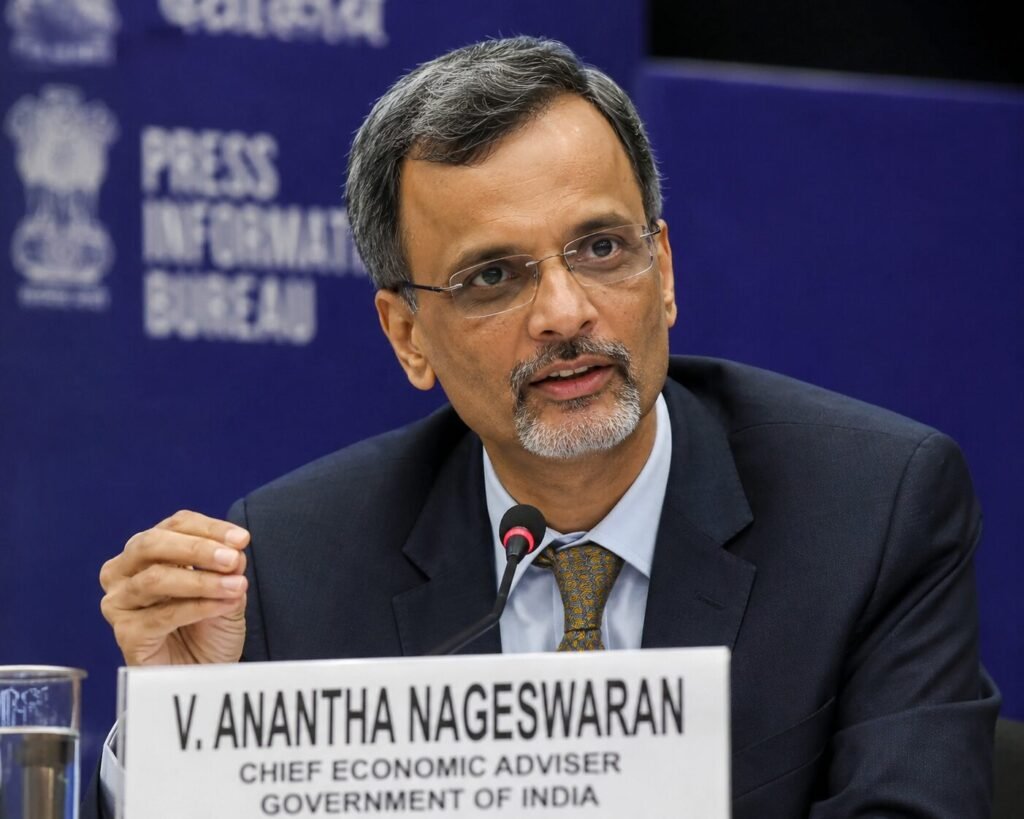
During a June 14 exclusive interview with ANI, V. Anantha Nageswaran delivered an unequivocal warning about the market.
“The stock market, AI-related stocks and AI-related valuations are definitely a bubble. There is no question about it,” he stated, according to ANI.
His core argument has three parts:
- AI hype is fueling investment: According to him, many companies promote AI as a coming “productivity bonanza” to attract capital and sustain investor enthusiasm.
- The same narrative is creating worker anxiety: He argued that by emphasizing AI’s potential to cut labour costs, businesses have also heightened fears among employees about job security.
- The true impact on employment remains uncertain: In his view, a meaningful discussion about AI’s long-term effects on the labour market can only take place after today’s investment frenzy subsides.
He was careful to separate skepticism about market hype from skepticism about AI itself. In his view, the technology will likely render certain IT skills outdated, as past technological advances have done, but its long-term impact on employment is still uncertain.
Why the Speaker Matters
Unlike a detached observer, Nageswaran has deep roots in the investment world. Before taking on a government role, he built his career in global finance, leading research at Credit Suisse’s Asian private banking division and overseeing investments as Global CIO at Bank Julius Baer in Switzerland, per his official record.
A former CIO using the word “bubble” with no qualifier is a stronger signal than a politician doing it. He has priced asset cycles for a living.
The surprising twist: India is already inside the ecosystem he’s now describing as a bubble.
Here is what the wire copy left out. When the CEA talks about an AI bubble, he is not describing a distant Wall Street problem. India’s flagship IT firms have already taken the hit.
As concerns grew that AI could reshape the traditional outsourcing business, the Nifty IT index lost an estimated $68.6 billion in market capitalization in February, Reuters reported. All 10 of its constituents dropped between 16.8% and 27%.
The trigger was specific. The sell-off followed an Anthropic product that automates legal work like contract review, according to coverage of the rout. Tata Consultancy Services and Infosys led the value destruction.
The valuation math is brutal. JPMorgan ran a reverse discounted cash flow on the big three and found the market is pricing TCS, Infosys and HCLTech at 4 to 5.6 percent long-term revenue growth, well below their 7 to 8 percent historical average, as reported by Investing.com. In an extreme case of zero growth forever, the bank saw downside of up to 39 percent.
So there is a tension in the CEA’s own position worth naming. He says the bubble is in AI stocks and the job fear is overdone. But Indian IT has already been repriced for exactly that job fear. If he is right that the fear is overstated, those stocks may be oversold. If the market is right, his reassurance on jobs is too soft. Both cannot be fully true.
The Global Perspective: He’s Not Alone—The Real Concern Is the Market Structure
The CEA’s timing is notable. Days earlier, the Monetary Authority of Singapore warned that valuations were “relatively stretched” and concentrated in technology and AI, as reported by BitcoinEthereumNews. OpenAI has touched a $500 billion valuation. Anthropic nearly tripled to about $170 billion since March.
What makes this boom fragile is not just price. It is plumbing.
A cluster of the biggest players are financing each other in a loop. Chip makers invest in model labs, the labs commit to buying the chips, and the same dollars circle back as revenue, a structure Bloomberg has mapped in detail. Supporters call it a virtuous circle that locks in scarce supply. Critics hear an echo of the vendor financing that inflated the late-1990s telecom bubble. Anthropic CEO Dario Amodei has defended the deals as a reasonable way to fund a costly technology.
That is the real risk behind the CEA’s word. A market held up by companies paying each other does not need a recession to wobble. It needs sentiment to turn.
Key Questions and Simple Answers
Is AI a bubble?
By valuation, much of the AI trade shows bubble signs, and India’s CEA, Singapore’s central bank and several major investors agree. The technology being real does not make the prices reasonable.
Will it crash my portfolio?
A burst would hit large-cap tech hardest. Analysts generally expect a 20 to 30 percent repricing spread over time, not a single overnight collapse, per one data-led 2026 analysis. Index and ETF holders carry that exposure too.
Will AI take my job?
The CEA’s view is that the fear is ahead of the proof. Some IT skills will fade. A mass wipeout is unproven. Indian IT hiring and margins are the place to watch first.
When does it burst? Nobody knows the date, and anyone claiming one is guessing. The signal to watch is the capital cycle, not a calendar.
Why This Is Significant
Three takeaways, with the spin removed.
The warning is credible because of who gave it. A former global CIO calling a bubble outright is not noise.
India is exposed twice over. Indian IT has already been repriced for AI disruption, and Indian retail investors hold the global AI trade through funds. This is not a foreign story.
The fragile part is the financing, not the technology. AI tools will keep improving even if the stocks fall. The question the CEA raised, and did not fully answer, is what happens to jobs and capital when the market stops believing every promise.



















Leave a Reply