

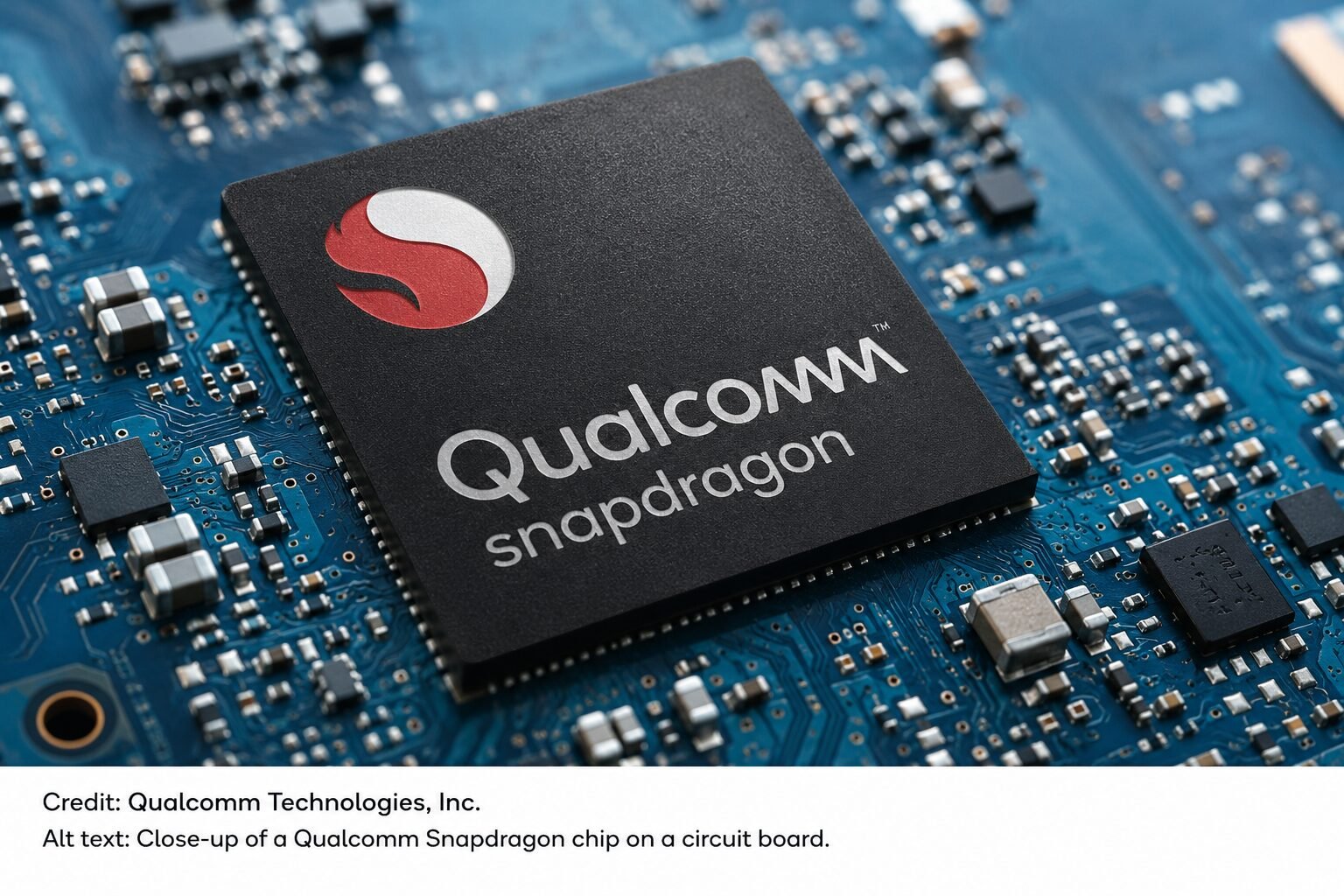
While many AI chipmakers trade at eye-watering multiples, Qualcomm continues to look surprisingly affordable. Investors often point to it as the budget-friendly path into the AI boom. The catch is that its discount isn’t simply a market oversight—it reflects the same realities that supporters and skeptics interpret in completely different ways.
The value case, in plain numbers
A “value play” is just a bet that a stock is priced below what the business is worth. On the headline measure, Qualcomm fits. As of June 19, the shares trade in the low-to-mid $200s, around $214, valuing the company near $225 billion to $233 billion at roughly 23 to 24 times trailing earnings, per market data compiled by WEEX. Earlier in the year the stock was even cheaper, changing hands near 13 times forward earnings, a steep discount to the broader tech sector.
Compared with AI heavyweights like Nvidia, AMD, and Broadcom, Qualcomm looks surprisingly restrained on valuation. For many investors, that’s the attraction. It offers exposure to the AI wave while avoiding the expensive price tags that have become common across the sector.
Before calling Qualcomm a value stock, it’s worth checking the calendar. The shares have been anything but stable in 2026, climbing from around $122 to as high as $260 within their 52-week range. As the stock surged, the pricing advantage that once stood out became significantly less pronounced.
Why it is cheap: Apple is leaving
The discount % is not a gift. It reflects a problem the whole market can see.
Qualcomm’s largest customer is walking away from one of its core products. Chief Executive Cristiano Amon has told analysts the company expects to supply modems for only about 20% of iPhones in 2026, and none at all by 2027, as Apple shifts to its own in-house chips. Bloomberg has reported the lost Apple modem revenue at roughly $5.7 billion to $5.9 billion a year, a meaningful hole for a company that once leaned on Apple for about a fifth of revenue. On top of that, a global memory-chip shortage has squeezed mid-range Android phone production, the bread and butter of Qualcomm’s handset business.
The Street has noticed. Qualcomm absorbed at least eight analyst downgrades through 2026, and BNP Paribas cut its price target sharply, citing “no end in sight” for smartphone weakness. So the cheap multiple is the market saying the core is shrinking. The value case is a bet that what replaces it grows faster than the old business fades.
The AI bet is about inference, not training

Here is the part that matters most for where AI is heading, and the part the “is it cheap” framing tends to skip.
Qualcomm is not trying to beat Nvidia at training the largest models. That is Nvidia’s fortress, and Qualcomm has not attacked it. It is aiming at the other half of the AI workload: inference, the work of actually running a trained model to answer a query, and edge AI, running models directly on a device. In October 2025 the company unveiled two data-center chips, the AI200 and AI250, built for inference rather than training. The AI200 is due in 2026 with 768 gigabytes of memory per card for liquid-cooled racks of up to 72 chips, and the AI250 follows in 2027 with a promised jump in memory bandwidth. Both are pitched on power efficiency and total cost of ownership, drawing on chip design honed over years in smartphones.
This is a smart read of the cycle. As AI moves from a training land-grab toward everyday deployment, the cost of running models at scale becomes the thing that hurts, and electricity is a big part of that cost. A chip that does inference using less power is a real selling point to data-center operators. Qualcomm has early proof points: a deal with Saudi-backed Humain to deploy 200 megawatts of its racks from 2026, a ByteDance order for millions of AI chips, and a plan to ship custom silicon to a large hyperscaler by the end of 2026. To shore up the networking side, it bought Alphawave Semi for $2.3 billion.
The other growth engines
The replacement story is not only AI. Qualcomm’s diversification is further along in automotive and the internet of things.
Qualcomm’s late-April earnings report underscored that its growth story extends well beyond mobile devices. Quarterly revenue came in at $10.6 billion, profits beat analyst estimates, and the automotive segment reached a new milestone with more than $5 billion in annualized revenue. A 38% rise in automotive chip sales and a long-term target of roughly $22 billion from automotive and IoT by 2029 suggest these divisions could carry much of the momentum while AI data-center revenues remain relatively modest.
The India angle the US coverage skips
For Indian readers, Qualcomm is not an abstract American chip stock. It is in the phone in your pocket.
Snapdragon processors power a large share of India’s Android market, especially the mid-range Xiaomi, Samsung and other devices that dominate here. That makes the memory shortage squeezing mid-range phones a direct line to Indian handset prices, not just a Qualcomm earnings footnote. The edge-AI push matters here too. On-device AI, the kind Qualcomm builds into Snapdragon, runs without a constant cloud connection, which fits a market where data cost and connectivity are real constraints. And as India builds out its own AI data centres, an inference chip sold on power efficiency and lower running cost is the kind of pitch that could travel to Indian operators watching their electricity bills. Qualcomm also runs large engineering operations in Hyderabad and Bengaluru, so its direction is an India tech-employment story as much as a Wall Street one.
So is it actually a value stock?
The honest answer is that it was a clearer one in April than it is now.
When Qualcomm sat near 13 times forward earnings and a 52-week low, with the Apple exit already known, the case that the bad news was priced in had teeth. After the rally to the high $250s on the ByteDance news and a strong quarter, the stock re-rated, and at 23 to 24 times trailing earnings it is no longer obviously cheap. It has become, in the words of one market write-up, an expectations stock, the kind that punishes any disappointment hard. The bull case from firms like Tigress Financial still sees large upside on a sum-of-the-parts view that prizes the auto and AI-edge segments. The bears point to a possible mid-single-digit revenue decline ahead, China exposure, and an AI data-center business that has shipped almost nothing yet.
Being “cheap” doesn’t automatically make a stock a bargain—it often means the market is pricing in uncertainty. Qualcomm could benefit as confidence in its AI roadmap strengthens, but any slip in execution could quickly change sentiment. This analysis is for informational purposes only and should not be viewed as financial advice. Ultimately, Qualcomm offers lower-cost exposure to AI because it carries risks that many pure-play AI companies don’t, leaving investors to decide whether the potential reward justifies those uncertainties.
What to watch next
- Qualcomm’s June 2026 analyst day, which should give a clearer read on the non-smartphone roadmap.
- The AI200’s actual 2026 launch and the promised hyperscaler shipment by year-end. Announcements have moved the stock; deliveries will decide the story.
- 2027, when Apple’s modem business is expected to hit zero. How well auto, IoT and AI fill that gap is the whole investment case in one number.





















Leave a Reply