

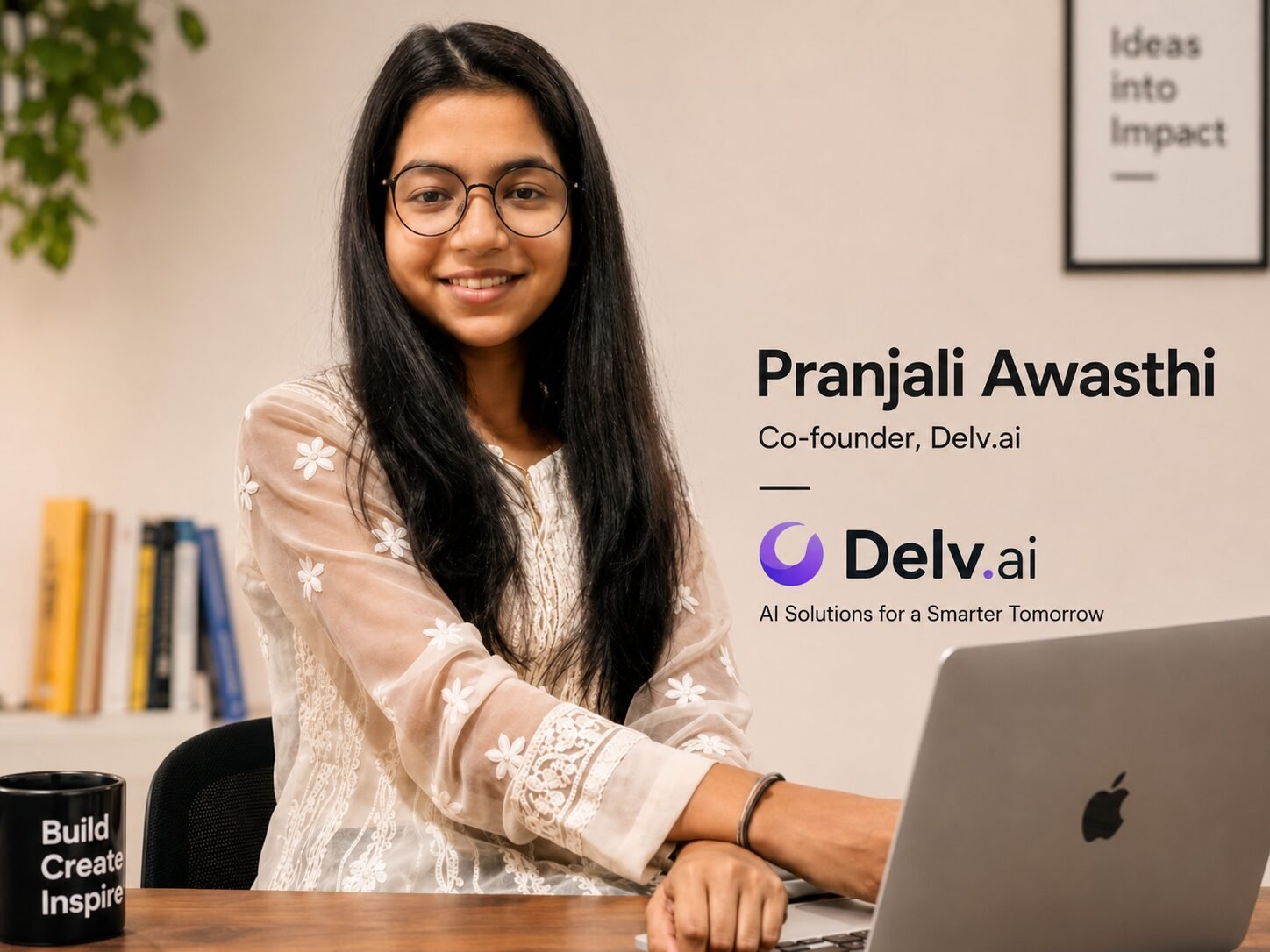
A familiar story is doing the rounds again: Pranjali Awasthi, the Indian-born teenager who taught herself to code at 7 and founded a ₹100 crore artificial intelligence startup at 16.
The accomplishment is real and impressive. The story being shared, though, is several years old, and the way the numbers are framed is worth correcting before anyone repeats them.
What actually happened ?
Pranjali Awasthi was born in India and lived there until she was 11, when her family moved to Florida. Her father, an engineer, introduced her to coding at 7. By 13 she was interning at research labs at Florida International University, working on machine learning.
In January 2022, at 16, she ( Pranjali Awasthi ) founded Delv.AI, a tool that uses AI to pull specific information out of large volumes of documents for researchers, cutting repetitive search work. She built it after going through HF0, a Miami startup accelerator, and presenting at its investor demo day in late 2021.
The funding and valuation, which are usually reported as one big number, are actually three different things:
| What you’ll see in headlines | What it actually means |
|---|---|
| “₹100 crore startup“ | A company valuation of about $12 million, reported in October 2023 |
| Often called her “net worth” | It is not. It is the company’s paper valuation, not her personal wealth |
| The cash behind it | Roughly $450,000 raised from investors including On Deck, Village Global, Backend Capital and the AngelList Quant Fund |
That distinction matters. A startup valued at $12 million on paper is not the same as a founder worth ₹100 crore in the bank, and the valuation itself is a 2023 figure that may not reflect the company today.
Where she actually is now ?
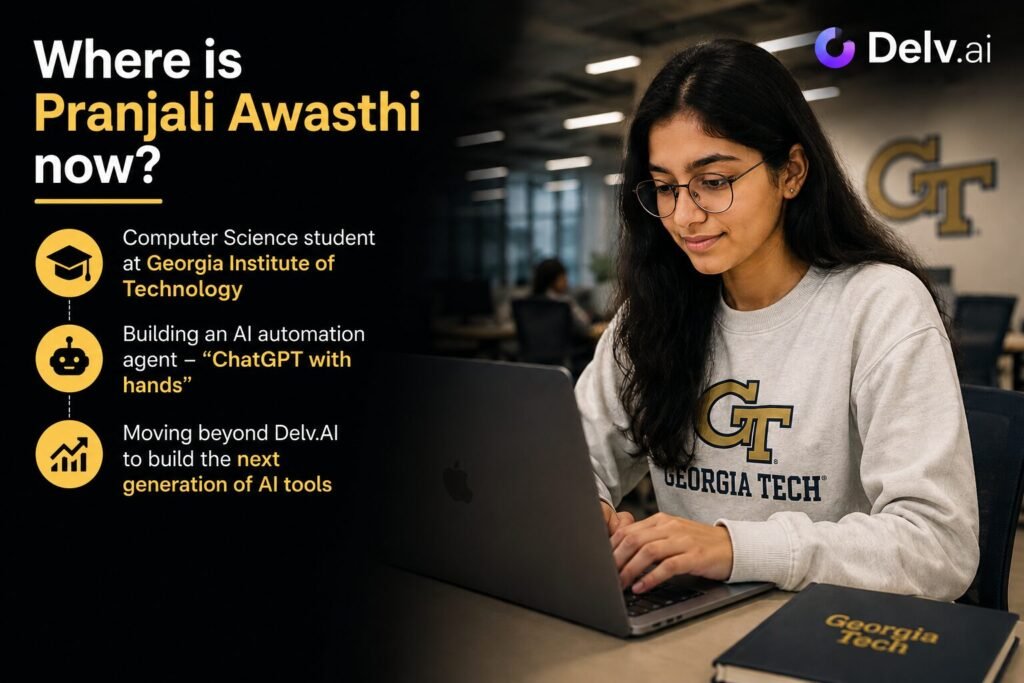
This is the part the recycled stories leave out. Pranjali Awasthi was 16 when she founded Delv.AI in early 2022. She is now a computer science student at the Georgia Institute of Technology, which makes the “16-year-old founder” headline several years out of date.
She has also moved on to new work. Georgia Tech’s own coverage describes her building an AI automation agent she has called “ChatGPT with hands,” a tool meant to carry out tasks rather than just answer questions. The public trail on Delv.AI itself largely stops in 2023, so the honest summary is not “teen runs ₹100 crore company today.” It is “teen built and funded a real AI product, then went to college and started building the next thing.”
The teen-founder story, handled honestly
Pranjali Awasthi belongs to a wave of very young founders that Indian and US media love to profile, alongside names like the founders of Induced.ai and other school-age startups. The attention is understandable. The work is genuinely advanced for someone that age, and her story, an Indian-origin girl encouraged into computer science early, resonates with readers who want to see that path exist.
But the same coverage tends to flatten her into a single frozen moment: the valuation, the age, the round number in rupees. It rarely asks the more useful questions. Did Delv.AI find lasting customers? Is it still operating? What did she learn that pushed her toward a new project? Those are the things that would actually tell you whether this is a durable career or a viral moment, and they are exactly what the repackaged versions skip.
Why Indian readers keep seeing this ?
For an Indian audience, Awasthi is held up as proof of homegrown tech talent, even though she has lived and built in the United States since she was 11. That framing says as much about India’s appetite for success stories in AI as it does about her. It is a reminder that the country produces and exports a steady stream of technical talent, and that the interesting question is less “look how young she is” and more whether that talent increasingly builds inside India or, like Awasthi, outside it.
The short version: a smart teenager built a real AI company, raised real money, and has since gone to university and started over on something new. That is a better and truer story than the one in the headline, and it does not need the inflation to be worth telling.
















Leave a Reply