

This article is intended for news and informational purposes only and should not be considered financial or investment advice. The author reports on market developments and does not provide personalized recommendations. Because stock prices can change rapidly, always verify the latest market data before making investment decisions.
Micron latest earnings highlight just how important AI hardware has become. The company, which supplies memory chips used in AI computing, reported record quarterly results on June 24. Sales jumped more than 300% year over year, profits increased dramatically, and its stock gained about 16% in the next trading session.
Micron latest news isn’t just about one company—it’s a signal of where AI is headed. In this guide, we explain the key details, why they matter, and the connection that makes the story especially relevant for India.
Micron Q3 results at a glance (reported June 24, 2026)
- Revenue: about $41.5 billion, more than four times a year ago
- Profit per share: $25.11, well above what Wall Street expected
- Profit margin: 84.6 percent, near a company record
- Stock move: up roughly 16 percent after the report
- Next quarter: Micron expects around $50 billion in sales
Figures are a snapshot, not live prices.
What Key Developments Were Unveiled in the Most Recent Report?
The numbers were big enough to surprise even optimistic analysts. Micron reported revenue of about $41.5 billion, up 346 percent from a year ago and up 74 percent from the previous quarter. Profit came in at $25.11 per share, beating the roughly $20 that analysts had expected.
The most telling number was the profit margin. Micron kept 84.6 percent of its sales as gross profit, compared with about 38 percent a year earlier. For a company that used to live on thin, swinging margins, that is a huge change.
The stock had already climbed to a record high before the report. After the results, it rose about 16 percent more.
Why High Bandwidth Memory (HBM) Is the Backbone of Modern AI
To understand the story, you need one piece of jargon, and only one: HBM.
HBM stands for high-bandwidth memory. It is a special kind of memory chip built by stacking layers on top of each other so data moves much faster while using less power. HBM sits right next to the main AI chips, like Nvidia’s, and feeds them data. Without enough HBM, those expensive AI chips simply cannot work fast enough to run large AI models.
Here is the catch. Only three companies in the world make this memory at scale: Micron, SK Hynix and Samsung. And right now there is not enough to go around. Micron has said it can meet only half to two-thirds of what customers want. When demand beats supply by that much, prices rise and profits follow. That is the engine behind Micron’s record quarter.
The really big news: locked in $100 billion of contracts
The headline numbers grabbed attention, but the most important announcement was easy to miss.
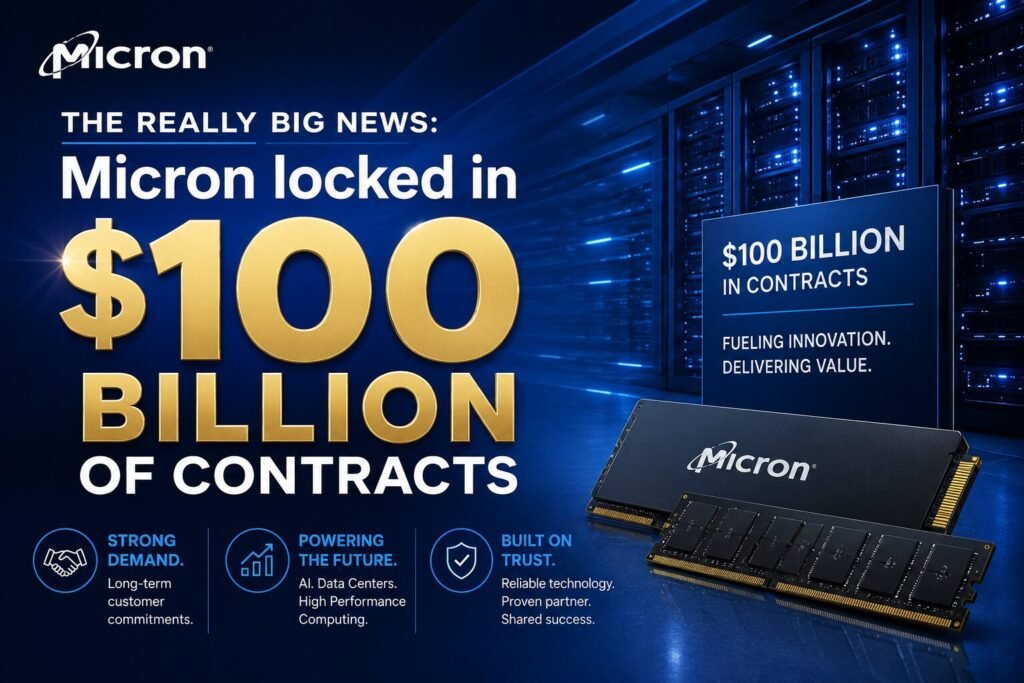
Micron revealed 16 long-term customer deals worth about $100 billion in guaranteed minimum sales, with about $22 billion paid upfront in cash by customers. These are “take or pay” contracts, which means the buyers commit to pay whether or not they end up needing all the chips.
Why does this matter so much? Because the memory business has always been a rollercoaster. Prices boom, everyone builds more factories, supply floods the market, prices crash. Investors have feared that cycle for decades. With these contracts, Micron is trying to do something no memory company has managed before: lock in its profits before the next downturn arrives. If it works, it changes how the market should value the company.
Why did the stock jump, and why are some still cautious?
A fair report shows both sides. Here they are, simply.
The bull case is straightforward. AI demand is far bigger than supply, Micron’s memory for all of 2026 is already sold out, and it has now locked in $100 billion of future sales. The big cloud companies, Amazon, Microsoft, Google and Meta, have together set aside more than $725 billion for AI data centres this year, and a lot of that money flows into memory.
The bear case is just as simple. Memory has always crashed eventually. Skeptics ask whether this is the top of the cycle, and worry that as Micron, SK Hynix and Samsung all build new factories, the extra supply could push prices back down in a year or two.
There is a timing point too. Micron’s blowout landed right after a shaky stretch for AI stocks, including a global sell-off on June 23 that knocked Nvidia and others. In that mood, Micron’s strong result acted as a reassuring signal that AI spending is still growing fast, not slowing.
AI Memory Manufacturing Gains Momentum in Gujarat
This is where the global story lands close to home, and it is something most international coverage will skip.
Some of Micron’s memory is now assembled in India. In February 2026, Prime Minister Narendra Modi inaugurated Micron’s $2.75 billion assembly and test plant in Sanand, Gujarat, India’s first commercial semiconductor facility. The plant takes finished memory wafers from Micron’s global network and turns them into the memory sticks and storage drives that go into devices.
The first batch made in India went to Dell for laptops built in the country. Once fully running, the Sanand plant could account for up to 10 percent of Micron’s worldwide output, with customers including Asus and Qualcomm. For India’s chip-making ambitions, a record quarter at Micron is good news for a plant that now carries part of that output.
There is a flip side for Indian shoppers, though. The same shortage that is making Micron rich is pushing up the price of memory in phones and laptops. If your next handset or laptop costs more than you expected, this AI memory boom is one of the reasons.
Inside Micron’s Latest Earnings Report: Highlights and Takeaways
| Item | Figure (Q3 FY2026) |
|---|---|
| Revenue | About $41.5 billion (up 346% from a year ago) |
| Profit per share | $25.11 |
| Gross margin | 84.6 percent |
| Operating cash flow | $25.39 billion (record) |
| Long-term contracts signed | 16 deals, about $100 billion |
| Upfront cash from customers | About $22 billion |
| Next quarter sales guidance | About $50 billion |
| Stock reaction | Up about 16 percent |
Figures from Micron’s results, as reported by TradingKey and Tech Times. Prices are not live.
Who Powers AI with Memory Technology? Meet the Market Leaders
| Company | Rough HBM market share | Notes |
|---|---|---|
| SK Hynix | Largest | Leads, and supplies Nvidia |
| Samsung | Second | Adding capacity |
| Micron | About a quarter | Gaining ground with its HBM4 chip |
Micron is the smallest of the three but says its next-generation HBM4 chip is ramping up faster than its last one, which could help it close the gap.
What People Are Asking About AI Memory and High-Performance Computing
Why is Micron stock going up? It reported record sales and profits driven by AI memory demand, and locked in about $100 billion of future contracts.
What does Micron make for AI? High-bandwidth memory, or HBM, the fast memory chips that sit next to AI processors and feed them data.
Is the memory boom going to last? Micron says supply will stay tight beyond 2026. Skeptics warn that new factories could eventually push prices down. Both views are live.
Does Micron make chips in India? Yes. Its plant in Sanand, Gujarat, opened in February 2026 and assembles memory, including the first modules for India-made Dell laptops.
Is Micron stock a buy? That is a personal decision this article cannot make for you. Do your own research or speak to a qualified adviser.
When did Micron report these results? On June 24, 2026, after the US market closed.
What to watch next
A few simple things will decide where the story goes:
- Whether the next quarter hits the roughly $50 billion Micron is guiding to.
- Whether memory prices hold up as new factories come online.
- How fast the new HBM4 chip ramps, since it could win Micron more business.
- Progress at the new factories, including the India plant and a giant new site in New York.






















Leave a Reply