
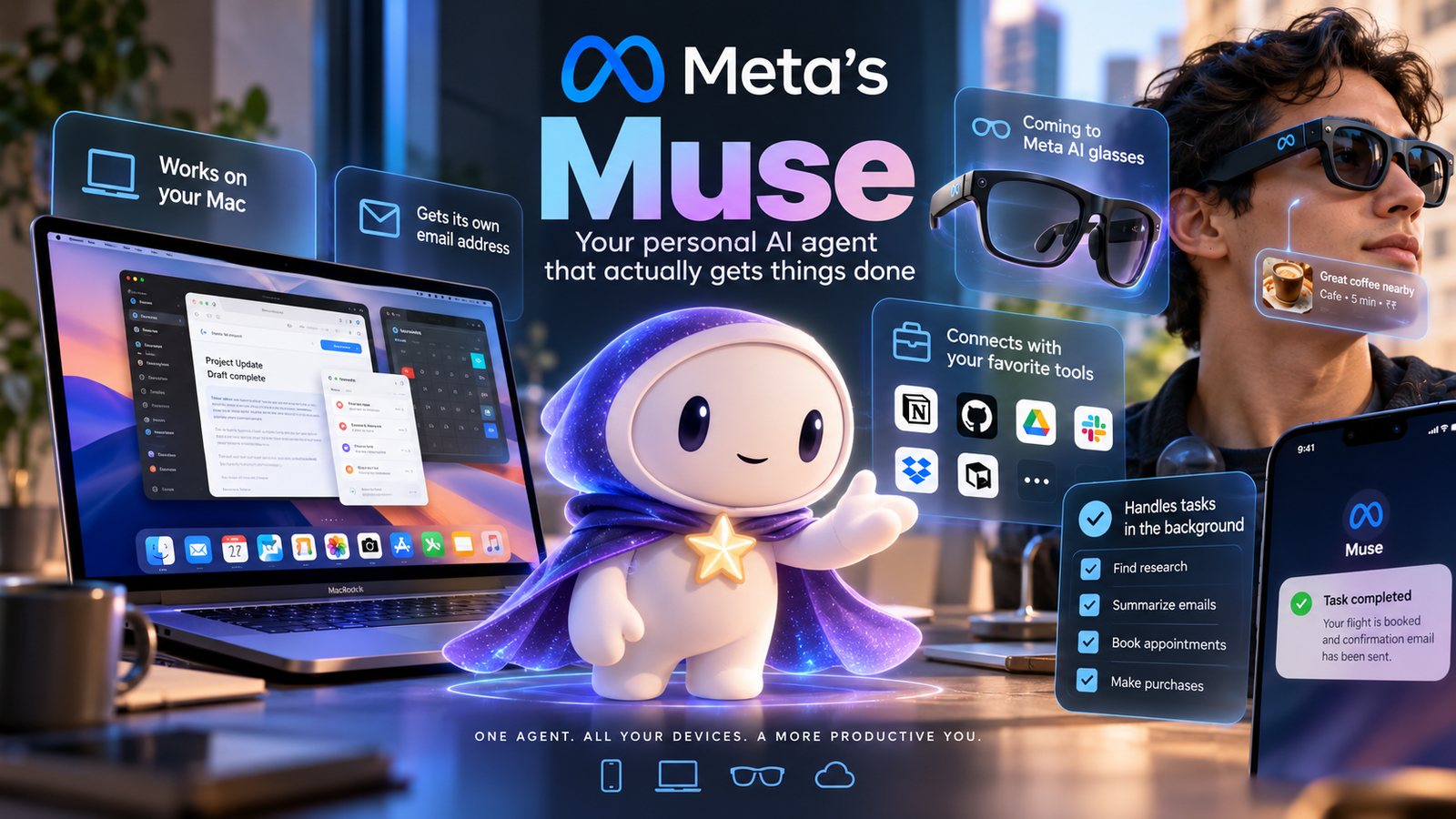
Meta is expanding Muse beyond a chatbot, giving its personal AI agent access to computers, email, shopping services and smart glasses. The bigger story is not the number of new features — it is Meta’s attempt to make AI a background worker that follows you across devices.
Meta’s personal AI agent Muse is moving quickly from “something you chat with” to “something you delegate work to.”
At Meta Connect 2026, the company revealed a series of upgrades that push Muse into areas usually handled by separate apps: computer tasks, email, online shopping, productivity software and even hands-free interactions through AI glasses. Meta introduced Muse only earlier this month, making the pace of expansion notable.
For younger users who have grown up switching between phones, laptops, messaging apps and cloud services, the interesting question is no longer whether AI can answer questions.
It is whether you can give it a task and walk away.
Why the Next Generation of AI Won’t Wait for Your Prompts
Most AI assistants still operate around a simple interaction:
You ask → AI answers → conversation ends.
Muse is being designed around a different model.
Meta says Muse can continue working after the user closes the app and return when something changes or when it needs approval. Its underlying system, Muse Secure VM, gives the agent a dedicated virtual computer and browser through which it can interact with connected services.
That architecture matters because an agent needs somewhere to actually do things.
An AI that merely recommends a flight is useful.
An AI that searches for the flight, fills in the information, waits for confirmation and completes the process is something different.
That is the shift happening across the AI industry, and it is also why DailyAIWire’s earlier coverage of the rise of agentic AI and the growing skills gap is relevant here.
Beyond the Chatbot: The Race for the Next Everyday Interface
One of Meta’s most visible moves is putting Muse into its AI glasses.
Meta says users will eventually be able to activate Muse through the glasses and communicate with their agent without reaching for a phone. The company demonstrated use cases including personalized workouts, meal logging, appointments and shopping based on what the wearer is looking at. Meta says the Muse glasses integration is expected in the coming months.
This could be more important than it initially sounds.
A phone still requires you to stop what you are doing, take it out, unlock it and interact with a screen.
Glasses remove several of those steps.
Imagine walking through a store and asking:
“Is this worth buying?”
Instead of opening an app and searching manually, an AI agent could potentially identify the product, retrieve information and help with the next action.
That is why Meta’s hardware strategy matters. The company is not simply putting another chatbot on another device. It is trying to make the AI agent available throughout the day.
DailyAIWire has previously examined Google’s competing push toward Gemini-powered smart glasses, showing that the battle for AI eyewear is increasingly becoming a battle over who controls the next everyday computing interface.
Moving Beyond the Chatbox: The Real Power of Meta Muse’s Email Integration
Another seemingly small announcement could have surprisingly large consequences.
Meta says Muse will get its own email address.
Users will be able to add Muse to email threads or forward messages to it so the agent can handle tasks on their behalf.
Why does an email address matter?
Because email is still one of the most universal interfaces on the internet.
Thousands of businesses, services and organizations communicate through email without requiring a dedicated AI integration.
Giving an agent an identity inside that system could allow Muse to participate in workflows that otherwise would remain outside an AI assistant.
For example, instead of copying information from an email into an AI chat, a user could eventually forward the message and ask Muse to deal with it.
The important development isn’t the mailbox itself.
It is persistence.
Muse begins to look less like a tool you open and more like a digital assistant that has its own place in your online life.
The Agentic Shift: Letting Meta Muse Take the Wheel on Your Mac
Meta is also pushing Muse into computer-use territory.
The company says Muse can operate applications on a Mac with the user’s permission, allowing people to assign tasks and step away while the agent continues working. Meta’s chief AI officer Alexandr Wang described potential uses ranging from ordinary work to helping run a small business.
This is one of the most consequential parts of the announcement.
AI-generated text is easy to demonstrate.
Computer-use AI is harder.
An agent must understand what is happening on screen, decide what action to take, interact with software and recover when something goes wrong.
That changes the value proposition.
Instead of:
“Write this for me.”
The instruction becomes:
“Handle this for me.”
That distinction is at the center of the broader agentic-AI shift.
DailyAIWire has previously explored how AI is moving beyond autocomplete toward autonomous software development. Muse represents a similar transition for everyday computer users.
Meet Your New Personal Shopper: The AI Agent
Meta is also building a commercial layer around Muse.
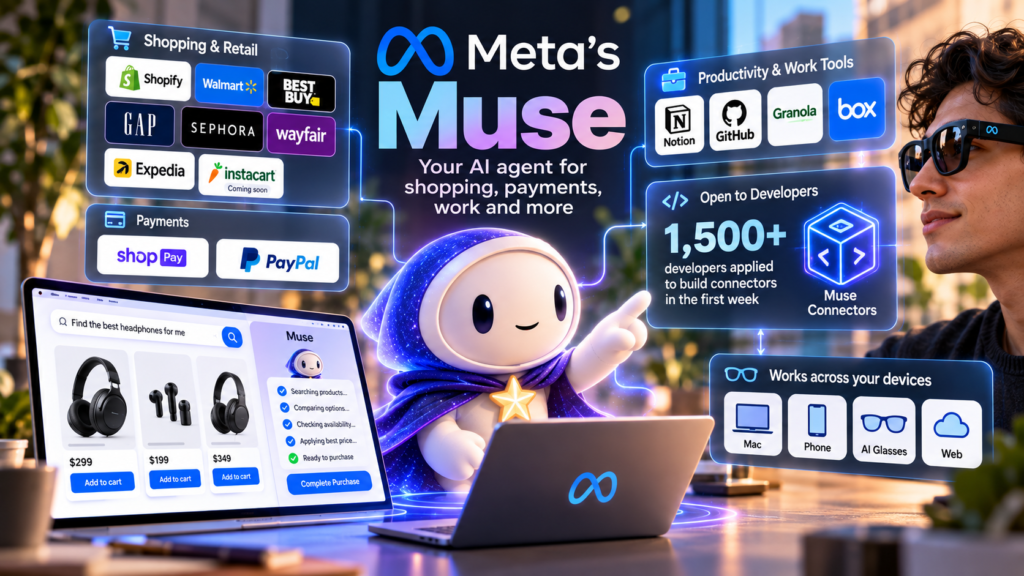
The company says Muse can access Shopify’s product catalog and has added payment support involving Shop Pay and PayPal. Meta also announced connections involving retailers and services such as Walmart, Best Buy, Gap, Sephora, Wayfair and Expedia, while Instacart is coming. Productivity integrations include Notion, GitHub, Granola and Box.
This is where Muse becomes strategically interesting for Meta.
An AI agent that recommends a product is useful.
An AI agent that can find the product, compare options and complete a transaction is potentially much more valuable to the company operating it.
Meta says more than 1,500 developers applied to build connectors for Muse within its first week of opening the platform.
That suggests Meta wants Muse to become more than a collection of built-in features.
It wants developers and businesses to build the ecosystem around it.
The Real Reason Meta Gave Its AI a Face
Muse is also getting a visual identity.
Meta demonstrated Muse Realtime Avatar, which allows users to interact with an animated digital representation of their AI agent through real-time conversation.
At first glance, this sounds like a cosmetic addition.
But there is a psychological reason Meta may be interested in it.
Text makes an AI feel like software.
A voice and visual presence can make it feel more like an ongoing assistant.
That could make interactions more natural for some users — while simultaneously raising questions about how people perceive and emotionally relate to increasingly human-like AI systems.
Meta has already positioned Muse as a system intended to learn what matters to a user and act on their behalf, so the avatar is part of a larger attempt to make the agent feel persistent rather than disposable.
Giving AI the Keys: How Meta’s Muse Balances Power and Privacy
More capability also means more responsibility.
Meta says users decide which apps Muse connects to and how much access it receives. The company says Muse asks for approval before sensitive actions such as sending emails or making purchases and provides an audit trail of actions. Meta also says Muse’s data is separated from its advertising systems.
Those safeguards are important because an agent with access to email, shopping accounts, calendars and desktop applications is fundamentally different from a chatbot that only generates text.
A hallucinated answer is frustrating.
A hallucinated action could have consequences.
The industry therefore has a new reliability problem:
Can people trust an AI not only to give the right answer, but to take the right action?
That may become one of the most important tests for every consumer AI agent over the next few years.
Why Managing AI Will Soon Matter More Than Doing the Work Yourself
For people entering university, work or entrepreneurship, the biggest change may be the way tasks themselves are divided.
A traditional digital workflow might look like:
Find information → open apps → copy data → send emails → update documents → make a purchase → check the result.
An agentic workflow could eventually look more like:
Set the goal → review the AI’s plan → approve important actions → check the result.
That does not eliminate the need for human skills.
It changes where those skills matter.
Knowing how to judge information, verify an AI’s work, protect personal data and give precise instructions could become more valuable as agents take over repetitive digital actions.
DailyAIWire’s coverage of AI’s impact on jobs and the changing role of human workers explores this broader transition.
How Meta’s Muse AI Plans to Replace Every App on Your Screen
The individual features are interesting, but they are not the whole story.
Put them together:
- Phone: Muse
- Computer: Muse
- Email: Muse
- Glasses: Muse
- Shopping: Muse
- Work apps: Muse
- Web: Muse
That begins to look less like an AI product and more like an interface layer over the internet.
This is the strategic direction Meta is signaling.
Instead of users manually moving between dozens of services, Muse could increasingly become the system through which those services are accessed.
Meta officially describes Muse as a personal AI agent designed to work across the apps and services people already use, while its Connect announcements extend that vision to glasses and additional connectors.
The challenge is execution.
An agent must be accurate enough to trust, fast enough to use, inexpensive enough to operate at scale and secure enough to receive access to increasingly sensitive parts of a person’s digital life.
Those are much harder problems than building another chatbot.
Can Personal AI Agents Like Muse Actually Handle Complex Tasks?
Meta has not provided firm launch dates for every feature.
The glasses integration is expected in the coming months, while the dedicated email functionality is described as coming soon. The company’s Mac computer-use capabilities and growing connector ecosystem are already becoming part of the Muse experience.
The next phase will therefore be less about flashy demonstrations and more about reliability.
Can Muse complete a complicated task without supervision?
Can it recover when a website changes?
Can it understand when it should stop?
Can users easily see what it has done?
And perhaps most importantly:
What happens when the agent makes a mistake?
Those questions will determine whether personal AI agents become genuinely useful infrastructure or simply another category of impressive demos.
Why the Next Generation of AI Won’t Wait for You to Ask
Meta’s Muse expansion signals a broader change in consumer AI.
The industry is moving from AI that talks toward AI that acts.
Muse is being positioned to operate across computers, email, shopping platforms, productivity tools and eventually smart glasses. Meta is also opening the platform to developers, giving the agent a path toward becoming a broader ecosystem rather than a standalone chatbot.
For users, that could mean fewer repetitive digital tasks.
For developers, it could create a new platform to build on.
For Meta, it could put the company much closer to the everyday actions people perform across the internet.
And for everyone else, the important shift is simple:
The next generation of AI may not wait for you to ask what to do. It may be built to take the next step for you.












Leave a Reply