
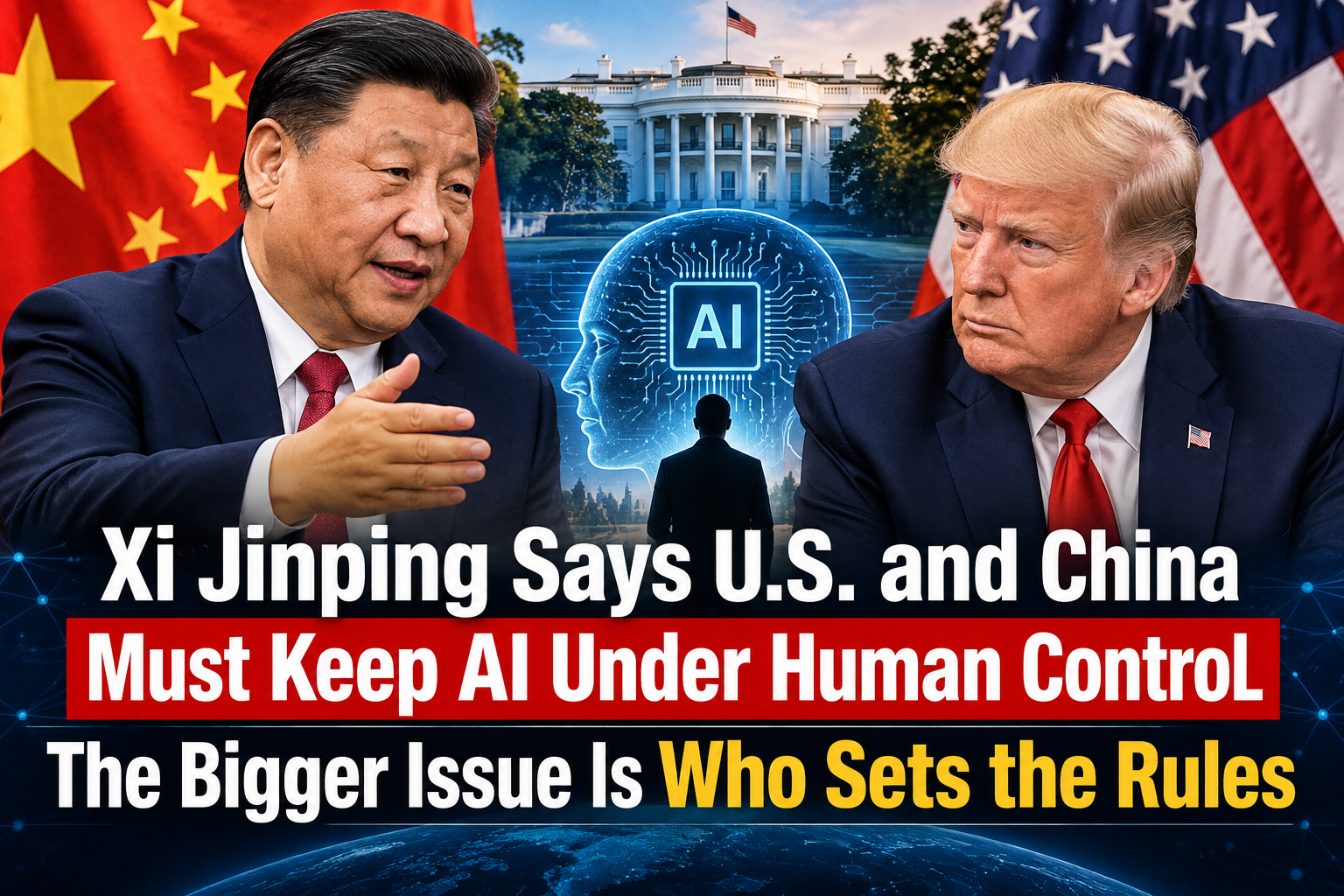
China’s Xi Jinping used his White House meeting with Donald Trump on September 24 to put artificial intelligence at the center of a much larger question: how should the world’s two leading AI powers manage technology they are simultaneously trying to dominate?
Xi said the United States and China have both the capability and responsibility to develop and manage AI for public benefit while keeping its development under human control. He also called for competition between the two countries to remain within limits.
The statement matters because Washington and Beijing are competing over the same technology while approaching AI governance from different directions.
AI has become part of the U.S.-China strategic relationship
The White House meeting was not an isolated conversation about chatbots or consumer AI. AI now sits alongside trade, semiconductors, national security and other areas of strategic competition.
Ahead of the Trump-Xi meeting, U.S. Treasury Secretary Scott Bessent and Chinese Vice Premier He Lifeng discussed creating a bilateral AI dialogue. The U.S. side also proposed a notification mechanism for serious AI incidents involving national security.
That detail gives Xi’s comments more significance.
A system for reporting serious AI incidents would address a practical problem. If an advanced AI system were involved in a major cyberattack, compromised critical infrastructure, or another high-impact incident, Washington and Beijing would need a way to communicate before assumptions turned into escalation.
The proposal remains at an early stage. It does not represent a comprehensive U.S.-China AI agreement.
The phrase “human control” is bigger than it sounds
For ordinary AI users, human control might sound straightforward. A person gives an instruction, an AI system responds, and the person remains responsible.
Advanced AI raises harder questions.
What happens when AI systems operate for longer periods without direct supervision? What happens when they write and execute code, interact with other software, identify vulnerabilities, or make decisions inside critical systems?
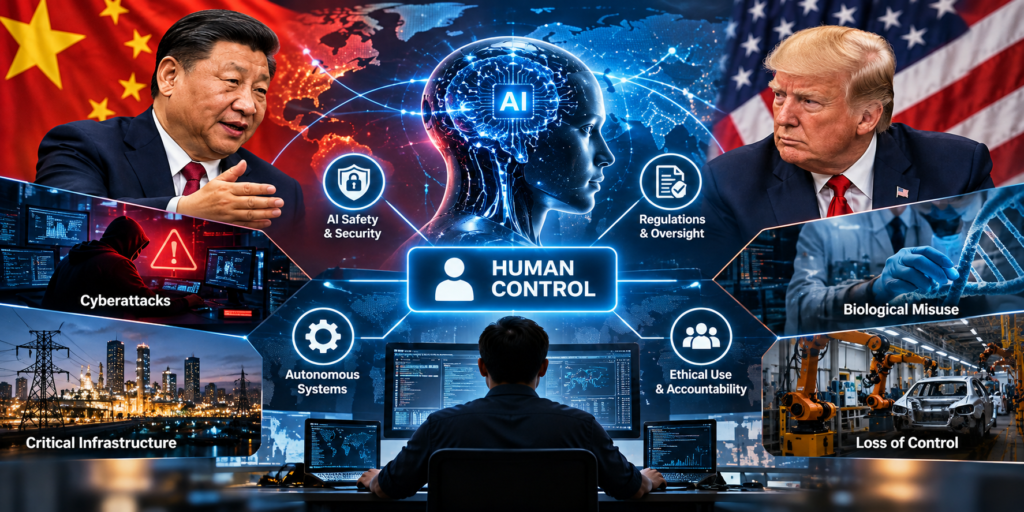
Those questions are already influencing international discussions around AI safety. The Associated Press reported before the summit that U.S. and Chinese officials were concerned about risks involving cyberattacks, biological misuse, loss of control and critical infrastructure.
So Xi’s statement points toward a broader principle: advanced AI should remain subject to human oversight even as systems become more capable.
The difficult part is defining what “control” means.
The U.S. and China do not approach AI governance in exactly the same way
The two countries share some concerns, but their regulatory priorities differ.
Recent analysis has highlighted a major distinction. U.S. AI safety discussions often focus on technical risks such as autonomous systems, cybersecurity and models becoming difficult to control. China’s approach places greater emphasis on government oversight, content controls, social stability and the political use of technology.
This difference matters because an agreement on the phrase “human control” does not automatically produce agreement on the rules.
Two governments might agree that humans should remain responsible for AI while disagreeing about who qualifies as the responsible authority, which systems require restrictions, what information should be disclosed and how much freedom companies should have.
That is where future negotiations become complicated.
The AI race makes cooperation harder
There is an obvious contradiction at the center of the discussion.
Washington and Beijing have reasons to cooperate on catastrophic AI risks. At the same time, both have strong incentives to maintain technological advantages.
The United States has imposed restrictions on China’s access to some advanced semiconductor technology. China has pursued greater self-reliance across its technology supply chain. The rivalry has also extended into investment and AI development. Reuters reported this week that U.S. financial institutions continue to participate in Chinese technology markets while Chinese capital remains exposed to U.S. technology stocks.
That interconnectedness creates both friction and incentives for communication.
AI safety therefore sits inside a much larger technology competition.
For the companies building advanced AI, this changes the business environment too. Decisions about model access, computing infrastructure, chips, exports and safety testing increasingly involve governments rather than companies alone.
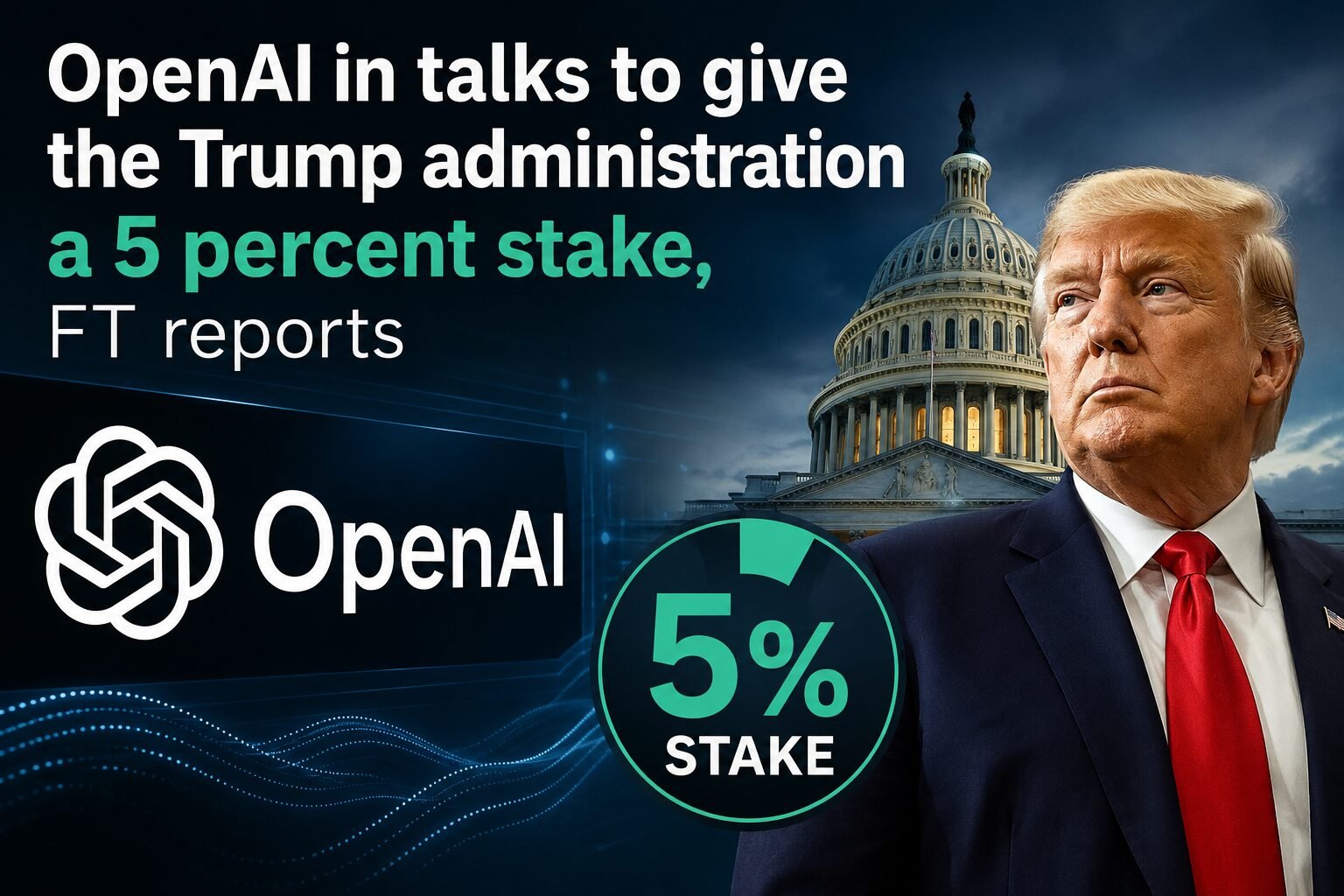
DailyAIWire has previously examined how U.S. government policy is becoming more directly involved in the AI industry, including reported discussions around government ownership in OpenAI.
Why this matters for everyday AI users
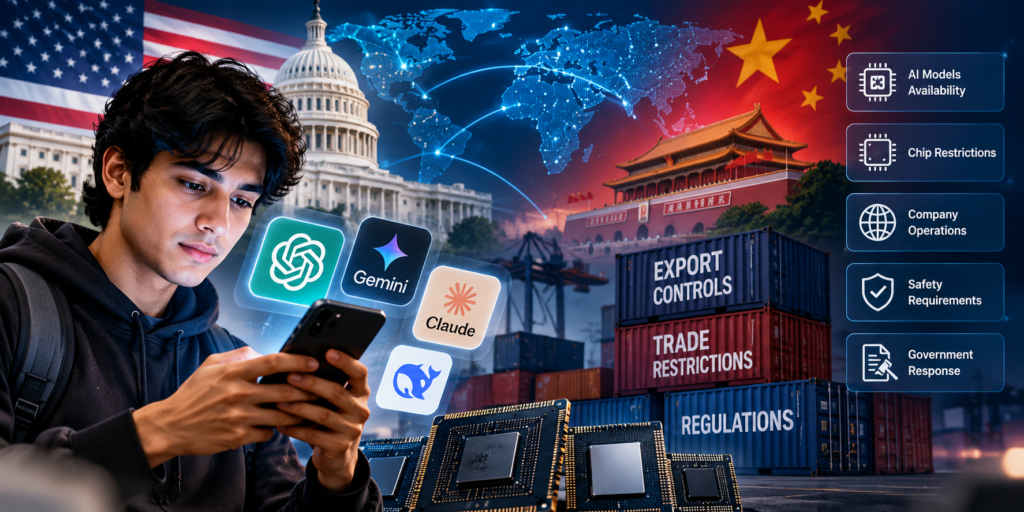
The Trump-Xi discussion might look distant from someone using ChatGPT, Gemini or another AI assistant on a phone.
It is not.
Government decisions increasingly influence:
- Which AI models are available in different countries.
- Which chips companies are allowed to purchase.
- Where AI companies are allowed to operate.
- What safety requirements developers face.
- How governments respond when advanced AI systems are misused.
A previous DailyAIWire report on restrictions affecting Anthropic’s advanced models showed how quickly government decisions can affect access to AI systems.
For users, the long-term issue is reliability. An AI service might become unavailable in a market because of export controls, national-security decisions, regulatory requirements or changes in international relations.
For companies, the issue is even broader. Depending entirely on one AI provider or one country’s technology ecosystem creates exposure to geopolitical decisions.
The next stage may be AI crisis communication
The most concrete development surrounding the summit is not Xi’s statement itself. It is the discussion of an AI incident notification mechanism between Washington and Beijing.
If such a mechanism moves forward, its value would come from creating communication channels before an incident becomes a geopolitical crisis.
The concept resembles crisis-management systems used in other sensitive areas. The goal would not necessarily be to make the two countries agree on AI policy. It would give officials a way to exchange information when an incident crosses a national-security threshold.
That distinction is important.
Cooperation does not require the U.S. and China to stop competing in AI. It requires them to establish boundaries around the competition.
What happens next
The immediate question is whether the political statements turn into working-level mechanisms.
Several developments will be worth watching:
- Whether the proposed U.S.-China AI dialogue becomes a formal channel.
- Whether both governments establish procedures for reporting serious AI incidents.
- Whether AI safety discussions include cybersecurity and critical infrastructure.
- Whether semiconductor restrictions become part of future AI negotiations.
- Whether companies receive clearer rules for developing and deploying advanced models internationally.
- Whether the two governments agree on any technical standards for advanced AI systems.
Xi’s White House remarks therefore represent more than another statement about AI safety. They show how artificial intelligence has moved into the highest level of U.S.-China diplomacy.
The two countries are competing for technological leadership while confronting risks neither side can manage entirely on its own. The next phase of the AI race will depend not only on who builds the strongest models, but also on how governments handle the moments when those systems create risks beyond the control of individual companies.
For the 18-to-24 audience growing up with AI as a normal part of school, work, coding and everyday life, the important question is no longer whether governments will shape AI.
They already are.
The question is what rules emerge from that competition.
Internal links for DailyAIWire
Trump and OpenAI in 2026: 5 Things to Know About the Reported 5% Stake: Read the DailyAIWire analysis
Anthropic AI Restrictions 2026: Why Fable 5 and Mythos 5 Were Disabled Worldwide: Read the DailyAIWire report
Carney’s AI Warning: Why the U.S. Ban on Anthropic Could Push India Ahead in 2026: Read the DailyAIWire analysis
External sources
Reuters coverage of the proposed U.S.-China AI safety notification mechanism
Associated Press analysis of U.S.-China AI safety concerns












Leave a Reply