


Apple has raised prices on MacBooks, iPads, Apple TV and HomePod, and India is the hardest-hit market in the world. Some models now cost tens of thousands of rupees more than before. The main reason is not greed or tariffs. It is the AI boom.
Here is what got more expensive, why India was hit worst, and the surprising chain that connects your costlier MacBook to data centres full of AI chips, all in plain language.
Apple price hike in India: the quick facts
- Affected: MacBooks, iPads, Apple TV, HomePod
- Not affected: iPhones, whose prices stayed the same
- Size of hike: roughly 14% to as much as 70%, the steepest of any major market
- Biggest jump seen: a MacBook Pro now costs ₹70,000 more
- Main cause: soaring memory chip prices, driven by AI
Apple Price Hike Hits Buyers: Here’s What’s More Expensive
The increases are real and large. According to a report by The Economic Times, prices in India rose by 14 percent to as much as 70 percent, making it the worst-hit major market in Apple’s latest revision.
The MacBook Pro saw the steepest jumps. The base 14-inch MacBook Pro with the M5 chip went from ₹1,69,900 to ₹2,39,900, a rise of ₹70,000. The top MacBook Pro with the M5 Max chip costs about ₹1,00,000 more than before. The MacBook Air rose by ₹30,000 to ₹35,000 depending on size, and even the entry-level MacBook Neo went up by ₹10,000.
iPads were hit too. The 13-inch iPad Air jumped from ₹84,900 to ₹1,19,900, a rise of about 41 percent.
Why Is India Facing the Biggest Apple Price Hike?
Apple raised prices in many countries, so why does India face the steepest hikes?
Three things stack up here. First, the global cost of memory chips has shot up for everyone. Second, the rupee has weakened against the US dollar, which makes imported products dearer. Third, India’s import duties and GST add another layer on top. Put together, India’s tax structure and currency amplified the global increase, so a price rise that is painful elsewhere becomes worse here.
The real reason: AI is making your MacBook pricier
This is the part most people miss, and it is the heart of the story.
Every computer needs memory, the chips that hold data while the device works. The same memory chips are needed in huge quantities inside the data centres that run AI. As companies race to build AI, they are buying up memory at any price, because it earns them far more money than selling it for laptops.
The result is a shortage for everyone else. Memory makers like Micron, SK Hynix and Samsung are sending most of their output to AI customers, leaving less for consumer devices and pushing prices up sharply. Industry tracker TrendForce says RAM prices rose by as much as 98 percent in early 2026 and could climb another 58 to 63 percent this quarter.
You can see who is winning. Micron just reported a gross profit margin of about 85 percent, a record, up from far lower levels a year ago. The memory suppliers are reaping the gains of the AI boom, and shoppers are paying the bill. Apple is simply the most visible company passing that cost on. Its own chief executive, Tim Cook, warned analysts in April that higher memory costs were coming and would weigh more heavily on the business in the months ahead.
Apple Price Hike: Why the iPhone Escaped While Other Products Got More Expensive
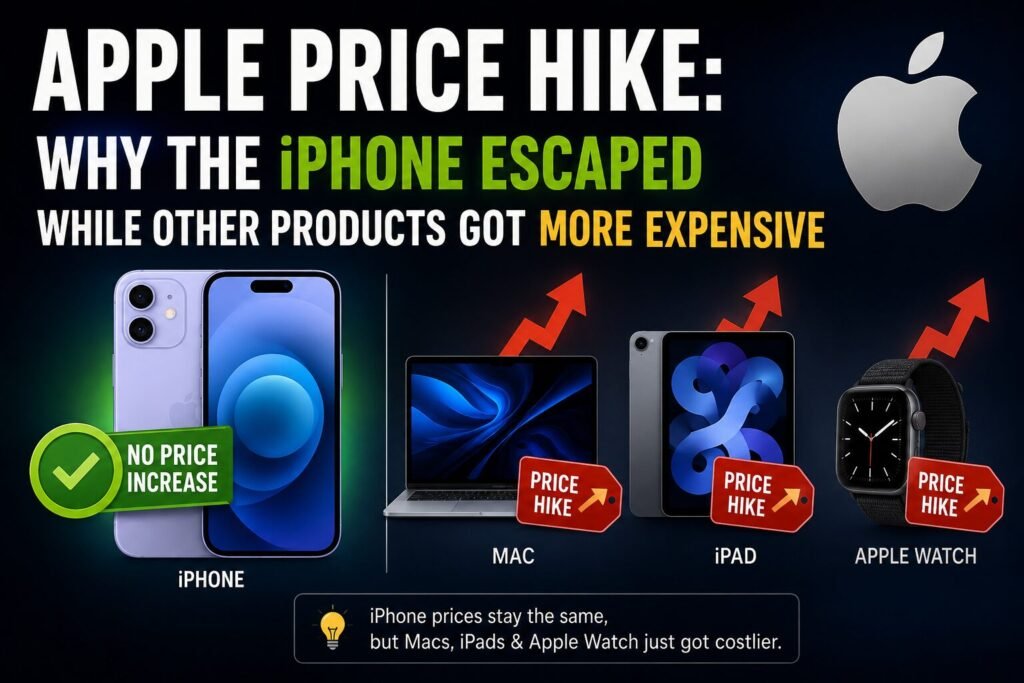
Here is a telling detail: Apple raised prices on Macs and iPads, but left iPhone prices unchanged.
Why? A few likely reasons. Laptops and tablets carry much more memory and storage than phones, so a memory price spike hurts their cost far more. Macs and iPads also tend to earn Apple thinner profit margins than iPhones, leaving less room to absorb the increase. And the iPhone is Apple’s biggest seller and its crown jewel, so the company has strong reasons to protect its price for as long as it can.
That protection may not last forever. If memory costs keep climbing, the iPhone could be next.
Apple Price Hike Ahead? Chinese Chips Could Change the Equation
There is one more twist that shows how tangled this has become.
Apple is reportedly asking the Trump administration for permission to buy memory chips from a Chinese company called CXMT, as it hunts for cheaper supply. The problem is that Washington restricts US companies from dealing with Chinese chipmakers on national security grounds. So Apple is caught between rising costs on one side and government rules on the other. The White House, Apple and CXMT have not commented.
For Indian buyers, the takeaway is simple. A quick fix is unlikely. Until the memory shortage eases or Apple finds new supply, prices are more likely to stay high than to fall soon.
Apple Price Hike: New India Prices for Every iPhone, Mac, iPad & More
| Product | Old price | New price |
|---|---|---|
| MacBook Pro 14-inch (M5, 16GB) | ₹1,69,900 | ₹2,39,900 |
| MacBook Air 13-inch (M5) | ₹1,19,900 | ₹1,49,900 |
| MacBook Air 15-inch (M5) | ₹1,44,900 | ₹1,79,900 |
| MacBook Neo (entry) | — | +₹10,000 |
| iPad Air 13-inch (base) | ₹84,900 | ₹1,19,900 |
Prices from Apple India’s website, as reported by India IPO and News24.
How the Apple Price Hike Could Impact Your Next Upgrade
A few practical points, as information rather than advice:
- Base models took smaller hikes than upgraded ones. Apple charges a steep premium for extra RAM and storage, and that premium grows as memory gets costlier. If you do not need a high-storage model, the gap is now wider than ever.
- Older stock may still carry old prices. Some sellers and older inventory might be priced before the hike, so it is worth checking.
- iPhones are unchanged for now, so if a phone meets your needs, the price pressure has not reached it yet.
What people are asking about the Apple price hike
How much did Apple raise prices in India?
By roughly 14 percent to as much as 70 percent on Macs and iPads, the steepest of any major market.
Why did Apple increase prices?
Mainly because memory chip prices have surged, driven by AI data centre demand, along with a weaker rupee and import taxes.
Did the iPhone get more expensive?
No. Apple left iPhone prices unchanged in this round.
Which Apple product saw the biggest hike?
The MacBook Pro lineup, with the base 14-inch model rising ₹70,000 and the top M5 Max model about ₹1,00,000 more.
Will Apple prices come down soon?
Unlikely in the near term. The memory shortage is expected to continue, and prices may stay high.
Is this only an Apple problem?
No. The whole consumer electronics industry faces the same memory cost surge. Apple is just the most visible example.
What to watch next
A few things will decide where prices go from here:
- Whether memory costs keep climbing, with another big jump projected this quarter.
- Whether the iPhone stays protected or eventually gets a price rise too.
- What Washington decides on Apple’s request to buy Chinese memory chips.
- Whether rivals follow, since other laptop and phone makers face the same pressure.














Leave a Reply