
Google has moved its conversational AI another step away from the traditional chatbot.
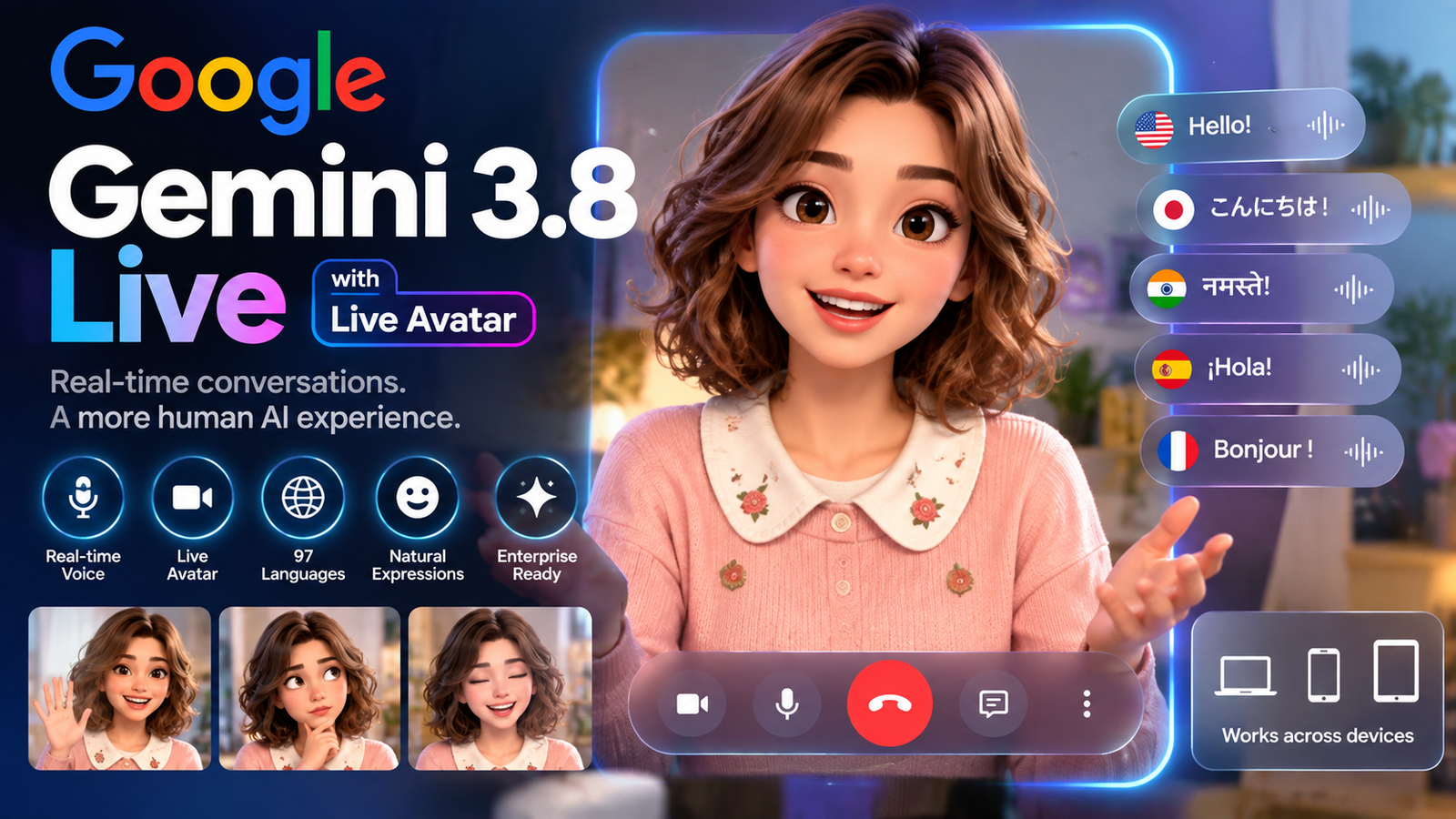
Gemini 3.8 Live with Live Avatar combines real-time voice conversation with generated video, allowing an AI agent to appear on screen as an animated person with synchronized speech, facial expressions and natural turn-taking. Google announced the technology on September 24, 2026, and made it generally available through Gemini Enterprise.
The important part is not the avatar itself.
It is the shift from AI as something you type into or speak with toward AI as something designed to maintain a visible, continuous presence.
Gemini 3.8: Why Google’s New Live Avatar is the Future of AI Conversations
Gemini 3.8 Live already focuses on real-time conversations. It processes audio, visual information and other inputs while maintaining a spoken exchange. Live Avatar adds a visual layer to that interaction.
The result is an AI agent that listens, sees and responds while displaying a synchronized digital character.
Google says the system supports synchronized lip movement, natural facial expressions and fluid conversational exchanges. Its developer documentation describes 24-frame-per-second avatar video output alongside 24 kHz audio.
This matters because human conversation involves more than words.
People look at faces. They notice pauses. They interpret expressions. They interrupt each other. They use visual cues to understand whether someone is confused, engaged or finished speaking.
Until now, most AI assistants have largely ignored this layer.
Google is attempting to bring some of it into the interface.
Gemini 3.8: Why Google’s Talking AI Avatars Are the Future of Digital Presence
The chatbot interface worked because text was easy to generate and easy to consume.
Voice assistants improved the interaction by removing the keyboard.
A talking avatar changes the relationship again.
Instead of seeing a waveform while an AI speaks, users see an entity responding to them.
For customer service, this distinction matters. Google specifically points to customer support and interactive walkthroughs as enterprise applications. A hotel agent, for example, could continue speaking with a customer while calling external systems in the background.
The agent does not need to stop the conversation while waiting for a database, CRM or API response.
That is more significant than having an attractive digital face.
The underlying architecture is moving toward agents that talk while they work.
Google is already pursuing this broader direction with its AI search agents, which are designed to monitor information and perform ongoing tasks rather than respond to a single search query. Google AI Search Agents: Stay Updated Automatically in 2026
The avatar is the visible part of a much larger transition.
Beyond Basic Translation: How Real-Time Language Switching Actually Feels Human
One of the more technically interesting features is multilingual conversation.
Google says Live Avatar supports 97 languages and automatically adjusts lip synchronization and facial expressions when a conversation switches languages. The company says this happens without degrading video fidelity or producing visual drift.
That creates an important distinction from traditional translation.
Translation changes the words.
Google is trying to synchronize the entire presentation.
A person could begin speaking in one language and switch to another during the same conversation. The avatar is designed to follow the change without requiring the user to manually select a new language.
For global businesses, this opens obvious possibilities in customer support, travel, education and guided services.
It also fits Google’s broader push toward multilingual AI. Earlier this year, Google expanded Gemini Live’s conversational support to more than 25 Indian languages and dialects, including Bhojpuri, Maithili and Sanskrit.
For India, the direction is particularly relevant.
A multilingual voice interface paired with a visual avatar has a different potential from an English-first chatbot. It lowers the amount of typing required and makes the interaction more familiar for people who prefer speaking.
But language support alone does not guarantee useful local experiences. The quality of regional-language understanding, pronunciation, cultural context and access to local services will matter just as much.
How Gemini 3.8 Live Avatars Will Actually Work in the Real World
There is a detail easy to miss in the excitement around the technology.
Live Avatar is not being introduced as a general consumer feature.
Google says Gemini 3.8 Live with Live Avatar is available in Gemini Enterprise. Custom avatar creation is also restricted to selected enterprise customers through an allowlist.
So the immediate impact is more likely to appear inside businesses than on ordinary consumer phones.
Companies could deploy branded digital agents for support, onboarding, training or interactive services.
A bank could have a virtual assistant explain a process.
A retailer could build a product-support agent.
A hotel could use an avatar for check-in assistance.
An education company could build interactive tutors.
The technology does not remove the need for a human employee in these situations. It changes where automation enters the interaction.
That distinction will matter as companies decide which conversations should remain human and which ones are suitable for AI agents.
Gemini 3.8 Live Avatar: Why Google is Finally Giving AI a Face
Google’s recent Gemini releases show a consistent direction.
The company is pushing AI beyond question answering.
Gemini 3.8 Live was introduced as a real-time conversational model capable of handling visual inputs, maintaining dialogue and executing tools in the background.
Google is also developing Gemini across Search, Workspace, Android and other parts of its ecosystem.
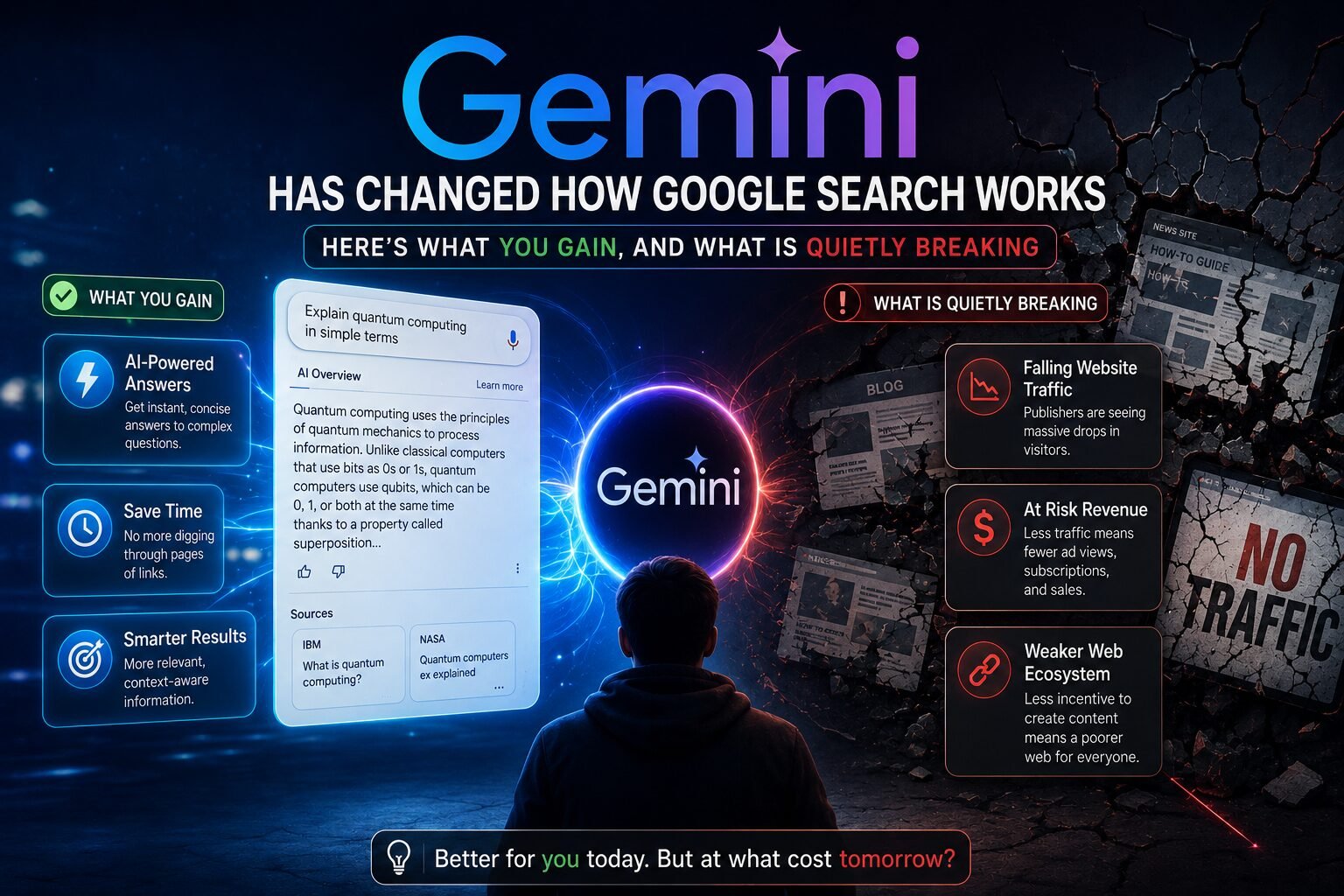
DailyAIWire previously examined how Google’s Gemini strategy is changing Search itself, with AI increasingly answering questions directly instead of sending users to traditional websites. Google Search Feels Smarter with Gemini, but There’s a Hidden Cost Behind the Convenience
Live Avatar fits the same broader movement.
The interface is changing.
First, people typed questions.
Then they spoke to AI.
Now AI is starting to look back.
That last step raises a different set of questions.
When an AI has a face, users might interpret its behavior differently. Facial expressions could make conversations feel more personal even though the system remains software.
That makes transparency important.
Google says generated audio and video from Live Avatar carry SynthID watermarks. The watermark is designed to remain imperceptible while helping identify AI-generated content.
That safeguard matters more as synthetic video becomes conversational and interactive.
A generated avatar that speaks naturally is harder for an ordinary viewer to distinguish from a recorded human interaction than a static chatbot response.
Why Gemini 3.8’s Lifelike Avatars Make Conversational AI Trust Harder, Not Easier
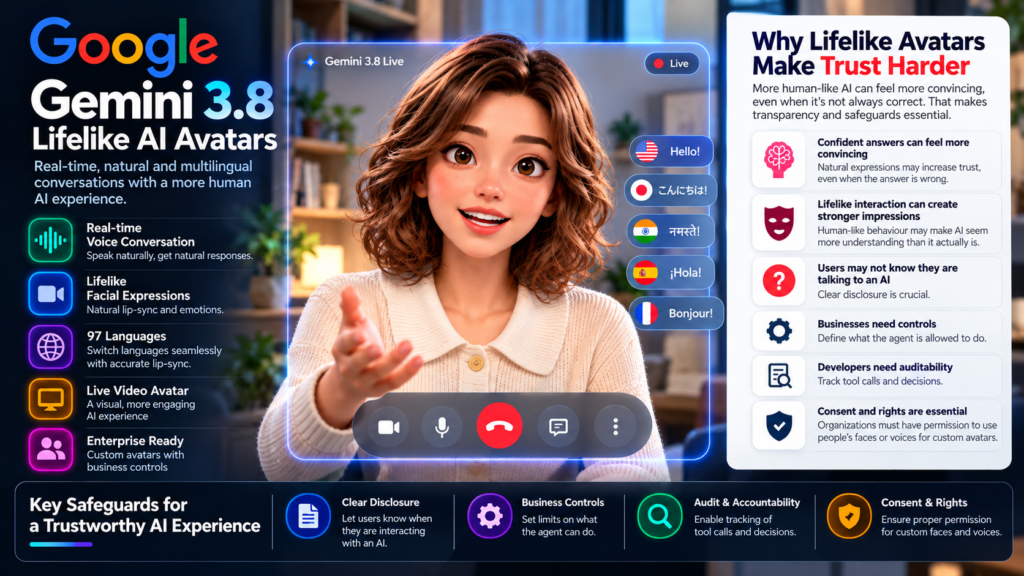
Better facial animation does not automatically make an AI more reliable.
It might make an incorrect answer feel more convincing.
This is one of the central challenges for conversational AI.
A system that speaks confidently while displaying natural expressions could create a stronger impression of understanding than its underlying reasoning deserves.
That puts pressure on companies to make the boundaries of AI systems clear.
Users need to know when they are talking to an AI.
Businesses need controls for what the agent is allowed to do.
Developers need ways to audit tool calls and decisions.
And organizations using custom avatars need permission from the people whose faces or voices they process. Google’s documentation explicitly places responsibility on customers to secure the necessary consent and rights for face and voice samples used with custom avatars.
The face is therefore not the whole product.
The surrounding controls are equally important.
Beyond the Novelty: When Your AI Learns to See, Talk, and Act
The most interesting future development will not be whether AI avatars become more attractive.
It will be whether they become useful enough to stay with you during complicated tasks.
Picture an AI agent helping someone fill out a form while explaining each step, checking information through an external system and responding to follow-up questions without restarting the conversation.
Or a technical-support agent watching a user’s screen while explaining what needs to be changed.
Or a multilingual travel assistant switching languages while helping a customer complete a booking.
Those experiences require several technologies to work together: perception, speech recognition, reasoning, tool execution, video generation and low-latency communication.
Google is now connecting those pieces inside one system.
That is why Gemini 3.8 Live with Live Avatar deserves attention beyond the novelty of an AI face.
The real development is the interface.
AI is becoming less like a page where you submit a prompt and more like a persistent software agent that talks, watches, responds and performs tasks.
The avatar is simply the part humans see.
For the technology industry, the harder question is what happens when these agents become good enough to handle an entire conversation from beginning to end.
Google has started building toward that future with Gemini 3.8 Live.
Now businesses have to decide where they want an AI with a face, and where they still want a human being.
Sources
Google: Introducing Gemini 3.8 Live with Live Avatar
Google Cloud: Gemini 3.8 Live with Live Avatar
Gemini 3.8 Live Developer Guide








Leave a Reply